Back to Blog
Why AI Search Keeps Routing Through YouTube: 2026 Data From 147,934 AI Search Queries

Chinmay Dhamapurkar
Data Scientist
5 min read

For Marketers and Analytics Leads
YouTube isn't a content channel to AI search engines. Across 147,934 queries, it looks more like infrastructure.
If you're a marketing director or analytics lead deciding how much AI search should change your channel plan, here's the finding to know first: two of the three major answer engines cited YouTube in every single brand project we measured this spring, whether or not the brand had ever uploaded a video.
On two platforms, YouTube showed up everywhere. Across 147,934 queries and 256 brand tracking projects (March 17 to July 10, 2026), Gemini cited youtube.com in 141 of 141 projects and Perplexity in 117 of 117.
SearchGPT is the outlier. It cited YouTube in 84 of 195 projects, under half, and its YouTube citation rate runs roughly 24 times lower than Gemini's.
The gap survived six checks. Including 108 matched projects that ran identical queries on both platforms: Gemini's YouTube citation share came out higher in all 108. Citation volume doesn't explain it, and neither does Google favoring its own product, since Perplexity shows the identical pattern.
The action isn't "make more videos." Audit what's already being cited about your brand on YouTube first, then test whether changing it moves your citations.
147,934 queries · 2.95M citation events · 256 brand projects · 3 platforms compared · 6 checks run
The Overlooked Pattern
Most SEO thinking treats YouTube as one channel among many. AI search engines don't.
We pulled 147,934 queries from 256 active brand tracking projects and logged every domain that showed up as a source in the AI-generated answer: 2,954,910 citation events in total. Then we asked one narrow question. When Gemini, Perplexity, or SearchGPT answers a query, how often does youtube.com show up as a cited source, and does that happen at the same rate across platforms?
It doesn't. And the gap is large enough, and stable enough, that it changes how a brand should think about YouTube: less as a channel you opt into, more as infrastructure that two of the three major AI platforms lean on whether or not your brand is there at all.
Everything below is six ways of stress-testing that finding before we would call it decision grade. A number like "100%" should make a marketer suspicious before it makes it into a board deck.
How We Measured This
What counts as a citation, and where the data comes from
What we counted
Where the data comes from
Platform Coverage
Seven platforms tracked. Three had enough volume to trust.
IQRush tracks seven AI platforms in production. Three of them, Gemini, Perplexity, and SearchGPT, had enough qualifying projects (and enough overlap between them) to support the comparisons this report leans on. The other four appear in the table below for reference, though with as few as seven qualifying projects, treat those figures as directional at best.
Platform | Projects tracked | Cited YouTube at least once | Presence rate | Share of all citations | In main comparison |
|---|---|---|---|---|---|
Gemini | 141 | 141 | 100.0% | 1.97% | Yes |
Perplexity Search | 117 | 117 | 100.0% | 4.74% | Yes |
OpenAI SearchGPT | 195 | 84 | 43.1% | 0.08% | Yes |
Google AI Overview | 38 | 38 | 100.0% | 6.92% | No (sample too small) |
Bing Copilot | 17 | 12 | 70.6% | 0.62% | No (too few projects) |
Claude | 22 | 1 | 4.5% | 0.00% | No (too few projects) |
Mistral | 7 | 3 | 42.9% | 0.03% | No (too few projects) |
Check 1 of 6
YouTube showed up in every Gemini and Perplexity project. In under half of SearchGPT's.
Across 141 Gemini projects, youtube.com was cited at least once in all 141. Perplexity showed the identical pattern across 117 projects. SearchGPT cited YouTube in 84 of its 195 projects, well under half.
A measured rate of 100% doesn't mean YouTube will show up in every project we haven't yet measured. It means it did in every one we did measure. The ranges below show how tight that claim actually is, and that tightness is what separates a decision-grade number from a headline number.
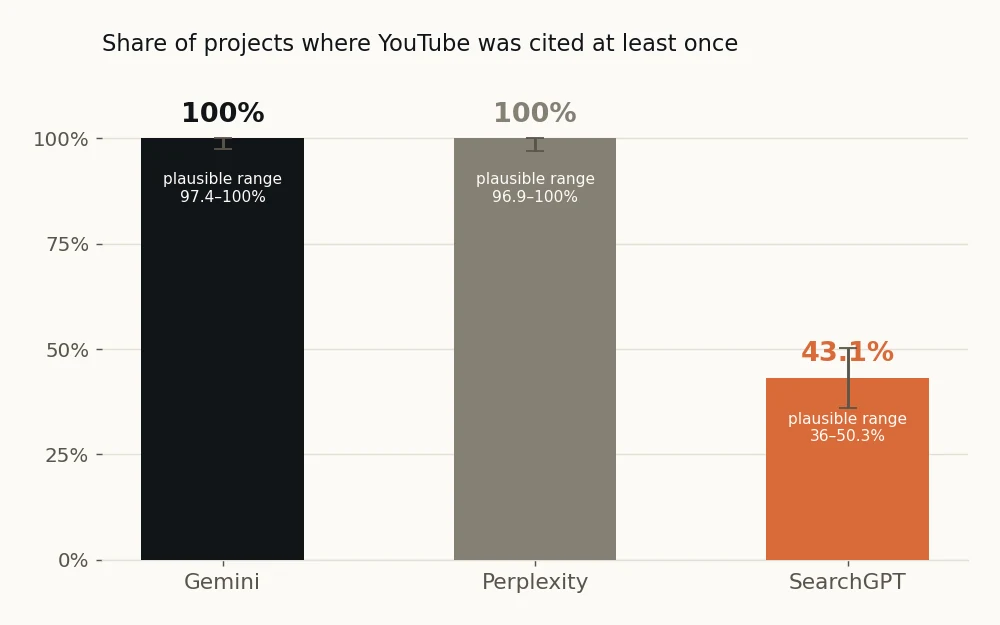
Fig 1: Share of projects where YouTube showed up at least once, by platform. One measurement per project (its most recent run), minimum 30 queries. The error bars show the range we'd expect the true rate to fall in, 95% of the time.
If Gemini and SearchGPT actually cited YouTube at the same underlying rate, seeing a gap this size by chance alone would be close to impossible.
For the statistically curious: chi-squared test
Check 2 of 6
Not a one-off snapshot. It held across every repeat run in the study window.
A rate based on a single snapshot per project could hide the fact that a platform is inconsistent week to week. So we looked at every repeated run for projects measured more than once. Gemini: present in all 152 repeat runs. Perplexity: all 198. SearchGPT: 47% of its repeat-measured projects had no YouTube citation in any observed run.
That stability is bounded to the study window, March through July 2026. AI platforms change how they retrieve and cite sources fairly often, so treat this as stable for now, not permanent.
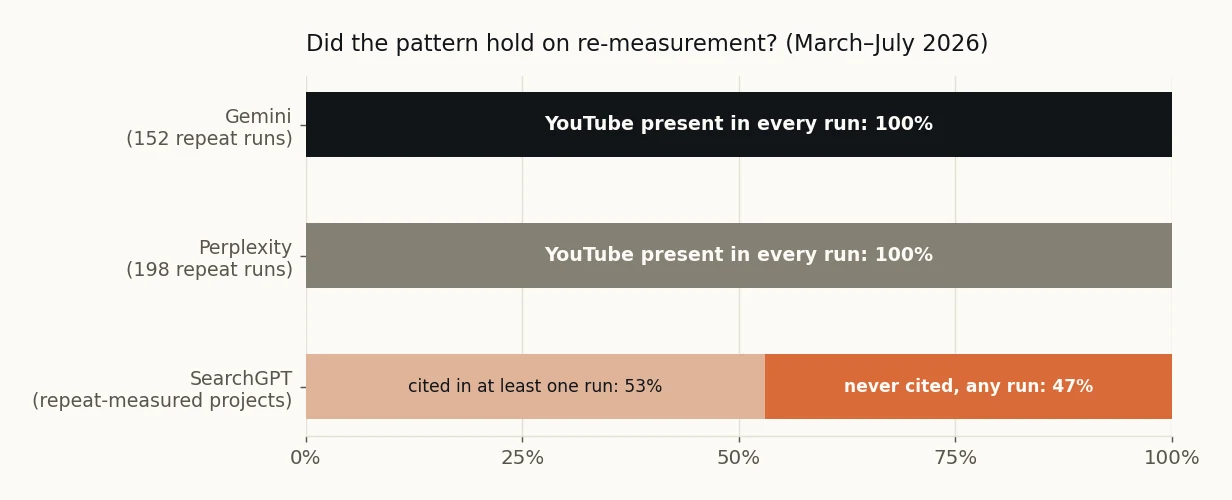
Fig 2: Of projects measured more than once, whether YouTube appeared in every run, at least one run, or none.
Check 3 of 6
Could this just be that Gemini cites more sources overall, giving YouTube more chances to show up?
Gemini's median project cited 9,718 sources; SearchGPT's cited 1,334. More citations means more chances for any one domain to appear. So we ran the numbers: if SearchGPT kept its own, much lower, citation volume but had Gemini's per-citation odds of citing YouTube (1.97%), what would the modeled chance of citing YouTube at least once look like?
Platform | Avg. citations/project | Median | Typical range | Share of citations that are YouTube | Avg. per-project YouTube share |
|---|---|---|---|---|---|
Gemini | 10,870 | 9,718 | 7,692–12,851 | 1.97% | 2.20% |
SearchGPT | 1,543 | 1,334 | 1,142–1,925 | 0.08% | 0.08% |
We ran a Poisson sensitivity model using Gemini's pooled YouTube citation rate of 1.97%. If SearchGPT retained its own median citation volume (1,334) but had that same per-citation rate, the modeled probability of citing YouTube at least once comes out to nearly 100%. At SearchGPT's own volume, matching Gemini's per-citation rate would make YouTube show up in nearly every project.
SearchGPT's actual YouTube citation rate, 0.08% of all citations, is roughly 24 times lower than Gemini's 1.97%. Volume isn't the explanation. The platforms are choosing to cite YouTube at different rates, not simply encountering it more or less often.
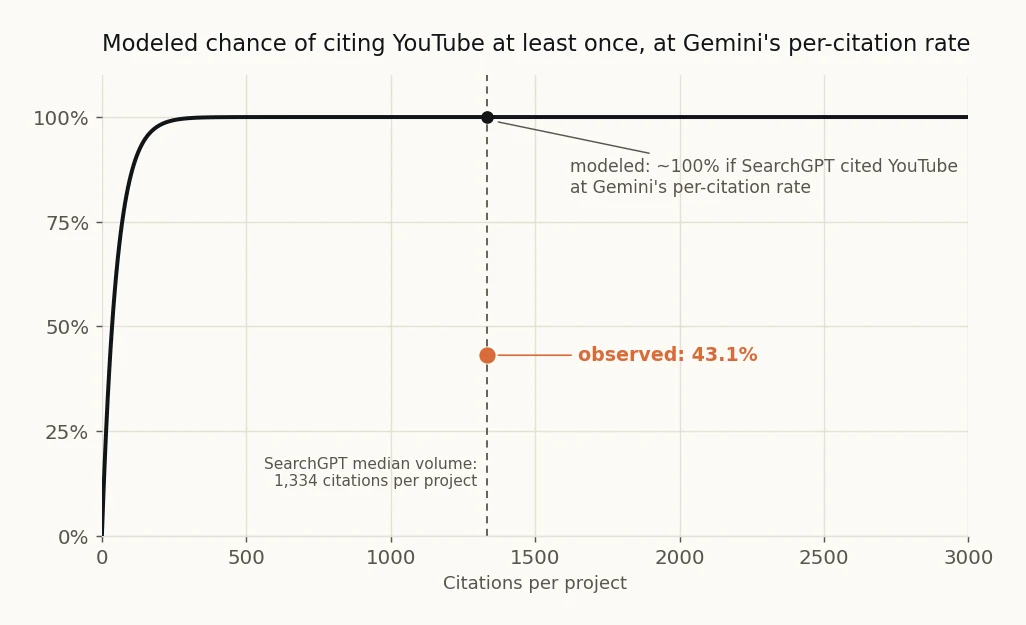
Fig 3: Modeled probability of citing YouTube at least once, at Gemini's actual per-citation rate, as citation volume per project increases. SearchGPT's typical volume is marked; even there, the model predicts YouTube should appear almost every time. In reality, it shows up 43% of the time.
Check 4 of 6
Same brand, same queries, same time: Gemini still cited YouTube more, in all 108 matched projects.
108 projects ran the exact same query set on both Gemini and SearchGPT. That controls for the most obvious alternative explanation, that SearchGPT users simply ask different kinds of questions. With the query set held constant, Gemini's YouTube citation share was higher than SearchGPT's in 108 out of 108 matched projects. Not most. All.
This is the strongest single piece of evidence in this report, because it's the closest thing to an apples-to-apples comparison the data allows. It still isn't a controlled experiment, though: retrieval systems, model versions, and index freshness differ between platforms in ways we can't separate from "platform" itself.
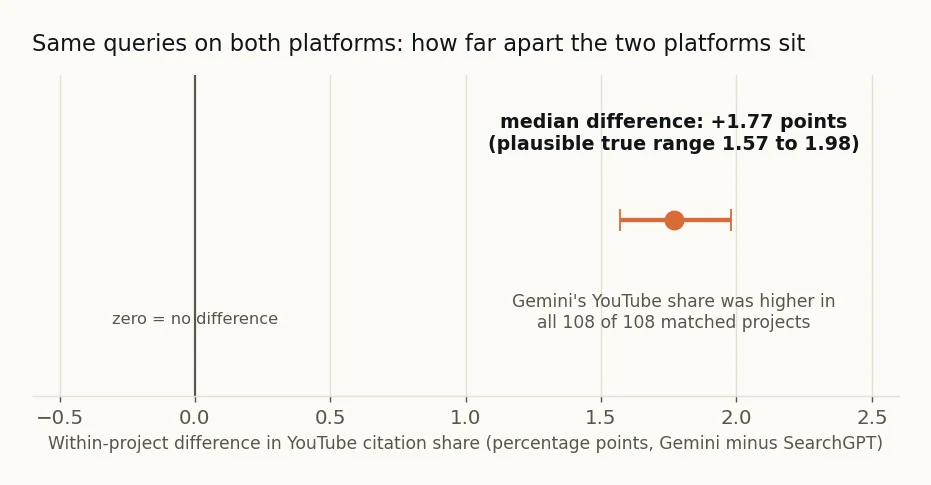
Fig 4: The typical within-project gap across the 108 matched projects. The dot is the median difference in YouTube citation share (Gemini minus SearchGPT); the whiskers are the plausible true range. Zero would mean no difference; the whole range sits well clear of it.
In plain terms: a matched-pair win rate of 108 out of 108 is not the kind of thing that happens by chance. Formally:
For the statistically curious: Wilcoxon signed-rank test (paired, 108 matched projects)
Check 5 of 6:
Zooming out to all Gemini and SearchGPT projects, not just the matched ones
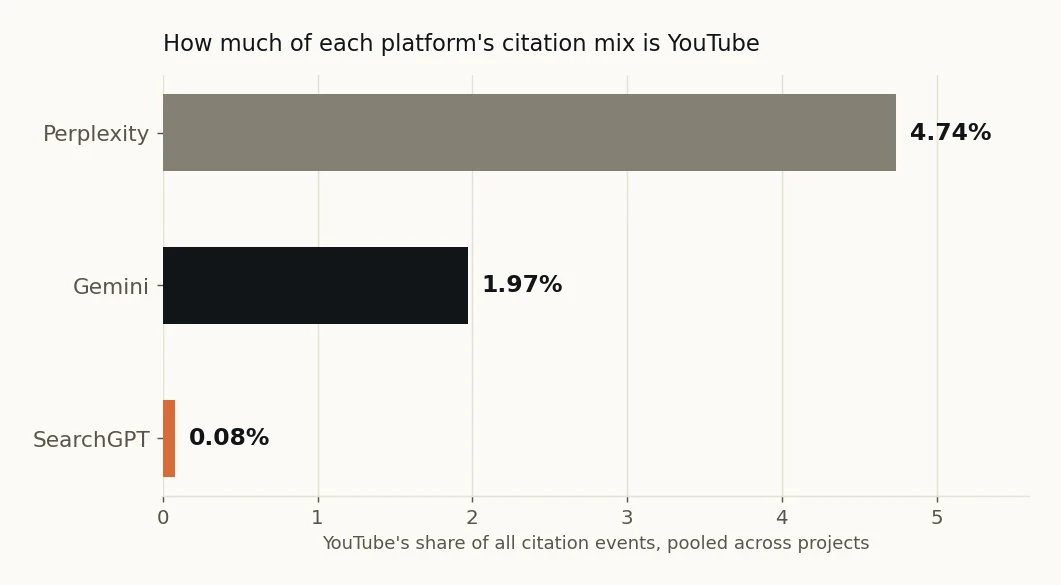
Fig 5: How much of each platform's citation mix is YouTube, pooled across all projects. Perplexity and Gemini give YouTube a real slice; SearchGPT's sits near zero.
Check 6 of 6
Perplexity has no ties to Google or YouTube. It shows the identical pattern.
The obvious explanation for Gemini's number is that Google owns YouTube and might favor its own product. Perplexity is a fully independent company with no ownership relationship to YouTube, and yet it showed the same 100% presence rate across 117 projects and 198 repeat runs.
Comparing Gemini and Perplexity directly, their citation-share distributions were statistically indistinguishable (Mann–Whitney p = 0.68). We can't detect a difference between them.
What This Doesn't Prove
Five things this data can't tell you, and why that matters before you act on it.
Why it happens. The pattern is consistent with AI platforms indexing YouTube transcripts, but we didn't observe that mechanism directly. Search-index composition, domain authority, or several other explanations could produce the same pattern.
Which videos are getting cited. We measured the domain, youtube.com, not the individual video. A citation could point to your official channel, a competitor's video, an independent reviewer, or something with nothing to do with your brand.
That publishing more video will get you cited more. A brand with zero official YouTube presence can still show up through someone else's video. Uploading content doesn't guarantee an AI platform will retrieve it.
That these are six independent proofs. They're six angles on the same dataset. Treat them as reinforcing, not as six separate studies arriving at the same answer by coincidence.
That this holds up next quarter. This is a snapshot of March through July 2026. AI retrieval systems and citation policies change, sometimes quickly.
The Evidence, at a Glance
All six checks, side by side
Check | Design | Main result | What it means |
|---|---|---|---|
Project presence | Gemini 141/141 vs SearchGPT 84/195 | 56.9-point gap | Big, clear difference in whether YouTube shows up at all |
Repeated runs | 152 Gemini runs, 198 Perplexity runs | 100% both platforms | Held steady every time we re-measured, within the study window |
Volume sensitivity | Gemini's pooled rate at SearchGPT's median volume | Modeled ~100% | Citation volume alone can't explain the gap |
Matched projects | 108 projects, same queries, platform varies | Gemini higher, 108/108 | Holds up even with brand, industry, and queries controlled for |
Unpaired distribution | All Gemini and SearchGPT projects | ~98% of random comparisons | Very large separation between the two platforms overall |
Perplexity comparison | Independent platform, 117 projects, 198 runs | 100% both levels | Rules out the simple Google-favors-its-own-product explanation, doesn't prove identical mechanism |
Marketer-Side Impact
The expensive mistake this data invites is the obvious one: reading "AI engines cite YouTube 100% of the time" as a mandate and greenlighting a \$100K-plus annual video production line on the spot. The domain-level stat can't tell you whose video is doing the citing. If the video Gemini keeps pulling for your category queries belongs to a competitor or a third-party reviewer, a new content budget doesn't fix that, and you'd be reallocating six figures against a number that was never decision grade for that call.
The cheaper first dollar is an audit: find out which videos are actually being cited on your category queries today, then decide what, if anything, to produce.
What Brands Should Actually Do
This finding isn't a mandate to post more videos; it's a reason to start watching a channel you don't control.
This data supports a narrower conclusion than "make more YouTube content." Gemini and Perplexity are already treating YouTube as a default source, whether or not your brand has ever uploaded a video there. The open question is no longer whether YouTube matters, but what's already being cited there about you.
Audit what's already citable. Search YouTube for your brand and category terms the way a prospective customer would, and note what an AI platform would find: whose videos, how accurate, how recent.
Monitor at the video level, not just the domain level. Knowing "YouTube got cited" is a start. Knowing which video, and what it says about you, is the actionable version.
Don't assume publishing fixes this. A brand with no channel can still be cited through third-party video. Uploading content is a hypothesis to test, not a guaranteed fix.
Compare yourself to competitors. If a competitor's video is the one getting cited in your category, that's a more specific problem than "YouTube matters."
Run it as an experiment. Publish or update specific video content, then track whether citation behavior actually changes, before and after. That's the only way to move from correlation to something you can act on.
Three questions to take into your next vendor or agency conversation
Can you show me which specific YouTube videos are being cited on my category queries, not just that youtube.com appeared as a domain?
Every platform-level number you report: what's the plausible range around it, and how many queries is it based on?
If we change our video content, can you re-run the same query set before and after and tell me whether the movement is real or noise?
Defensible Conclusion
Across 147,934 queries, 256 brand tracking projects, and 2,954,910 citation events, YouTube showed up in 100% of the Gemini projects measured, 100% of the Perplexity projects, and 43.1% of the SearchGPT projects. That pattern held across every repeat measurement in the study window. In 108 projects running identical queries on both platforms, Gemini's YouTube citation share was higher every single time. Neither obvious alternative explanation, more citations overall, or Google favoring its own product, survives scrutiny. What this establishes: for two of the three major AI platforms, YouTube functions as something close to default infrastructure for citations, not an optional channel. What it doesn't establish: why that's true, or that publishing more video content will change your outcomes.
Frequently asked questions
Does this mean my brand needs a YouTube channel?
Not by itself. The data shows AI platforms cite the youtube.com domain constantly; it doesn't show that brands with channels get cited more. A brand with no channel can be cited through a reviewer's or competitor's video. Audit what's being cited about you first, then treat publishing as an experiment to run, not a conclusion to buy.
Why does SearchGPT cite YouTube so much less than Gemini and Perplexity?
We don't know, and this study can't tell you. The gap is real and stable (it survived six checks), but the mechanism, whether index composition, retrieval design, or licensing, isn't observable from citation data alone. Be skeptical of anyone who tells you the "why" with confidence.
Do these results apply to my industry?
The 256 projects span the categories of real brands using IQRush in production, so the headline pattern is broad. But your category's numbers are your own: which videos get cited on your queries, and at what rate, is exactly what a baseline measurement of your brand answers.
Will this still be true next quarter?
Treat it as stable for now, not permanent. The pattern held across every repeat run from March 17 to July 10, 2026, but AI platforms change retrieval and citation behavior often, and sometimes quickly. That's an argument for ongoing measurement over one-time studies.
How do I find out which YouTube videos AI engines cite about my brand?
Run your real buyer queries through the platforms and log the citations at the video level, repeatedly, since single snapshots mislead. That's the baseline measurement IQRush runs in production. Contact us and we'll run one for your brand and send you the report.
Back to Blog
Why AI Search Keeps Routing Through YouTube: 2026 Data From 147,934 AI Search Queries
Chinmay Dhamapurkar
Data Scientist
5 min read
For Marketers and Analytics Leads
YouTube isn't a content channel to AI search engines. Across 147,934 queries, it looks more like infrastructure.
If you're a marketing director or analytics lead deciding how much AI search should change your channel plan, here's the finding to know first: two of the three major answer engines cited YouTube in every single brand project we measured this spring, whether or not the brand had ever uploaded a video.
On two platforms, YouTube showed up everywhere. Across 147,934 queries and 256 brand tracking projects (March 17 to July 10, 2026), Gemini cited youtube.com in 141 of 141 projects and Perplexity in 117 of 117.
SearchGPT is the outlier. It cited YouTube in 84 of 195 projects, under half, and its YouTube citation rate runs roughly 24 times lower than Gemini's.
The gap survived six checks. Including 108 matched projects that ran identical queries on both platforms: Gemini's YouTube citation share came out higher in all 108. Citation volume doesn't explain it, and neither does Google favoring its own product, since Perplexity shows the identical pattern.
The action isn't "make more videos." Audit what's already being cited about your brand on YouTube first, then test whether changing it moves your citations.
147,934 queries · 2.95M citation events · 256 brand projects · 3 platforms compared · 6 checks run
The Overlooked Pattern
Most SEO thinking treats YouTube as one channel among many. AI search engines don't.
We pulled 147,934 queries from 256 active brand tracking projects and logged every domain that showed up as a source in the AI-generated answer: 2,954,910 citation events in total. Then we asked one narrow question. When Gemini, Perplexity, or SearchGPT answers a query, how often does youtube.com show up as a cited source, and does that happen at the same rate across platforms?
It doesn't. And the gap is large enough, and stable enough, that it changes how a brand should think about YouTube: less as a channel you opt into, more as infrastructure that two of the three major AI platforms lean on whether or not your brand is there at all.
Everything below is six ways of stress-testing that finding before we would call it decision grade. A number like "100%" should make a marketer suspicious before it makes it into a board deck.
How We Measured This
What counts as a citation, and where the data comes from
What we counted
Where the data comes from
Platform Coverage
Seven platforms tracked. Three had enough volume to trust.
IQRush tracks seven AI platforms in production. Three of them, Gemini, Perplexity, and SearchGPT, had enough qualifying projects (and enough overlap between them) to support the comparisons this report leans on. The other four appear in the table below for reference, though with as few as seven qualifying projects, treat those figures as directional at best.
Platform | Projects tracked | Cited YouTube at least once | Presence rate | Share of all citations | In main comparison |
|---|---|---|---|---|---|
Gemini | 141 | 141 | 100.0% | 1.97% | Yes |
Perplexity Search | 117 | 117 | 100.0% | 4.74% | Yes |
OpenAI SearchGPT | 195 | 84 | 43.1% | 0.08% | Yes |
Google AI Overview | 38 | 38 | 100.0% | 6.92% | No (sample too small) |
Bing Copilot | 17 | 12 | 70.6% | 0.62% | No (too few projects) |
Claude | 22 | 1 | 4.5% | 0.00% | No (too few projects) |
Mistral | 7 | 3 | 42.9% | 0.03% | No (too few projects) |
Check 1 of 6
YouTube showed up in every Gemini and Perplexity project. In under half of SearchGPT's.
Across 141 Gemini projects, youtube.com was cited at least once in all 141. Perplexity showed the identical pattern across 117 projects. SearchGPT cited YouTube in 84 of its 195 projects, well under half.
A measured rate of 100% doesn't mean YouTube will show up in every project we haven't yet measured. It means it did in every one we did measure. The ranges below show how tight that claim actually is, and that tightness is what separates a decision-grade number from a headline number.
Fig 1: Share of projects where YouTube showed up at least once, by platform. One measurement per project (its most recent run), minimum 30 queries. The error bars show the range we'd expect the true rate to fall in, 95% of the time.
If Gemini and SearchGPT actually cited YouTube at the same underlying rate, seeing a gap this size by chance alone would be close to impossible.
For the statistically curious: chi-squared test
Check 2 of 6
Not a one-off snapshot. It held across every repeat run in the study window.
A rate based on a single snapshot per project could hide the fact that a platform is inconsistent week to week. So we looked at every repeated run for projects measured more than once. Gemini: present in all 152 repeat runs. Perplexity: all 198. SearchGPT: 47% of its repeat-measured projects had no YouTube citation in any observed run.
That stability is bounded to the study window, March through July 2026. AI platforms change how they retrieve and cite sources fairly often, so treat this as stable for now, not permanent.
Fig 2: Of projects measured more than once, whether YouTube appeared in every run, at least one run, or none.
Check 3 of 6
Could this just be that Gemini cites more sources overall, giving YouTube more chances to show up?
Gemini's median project cited 9,718 sources; SearchGPT's cited 1,334. More citations means more chances for any one domain to appear. So we ran the numbers: if SearchGPT kept its own, much lower, citation volume but had Gemini's per-citation odds of citing YouTube (1.97%), what would the modeled chance of citing YouTube at least once look like?
Platform | Avg. citations/project | Median | Typical range | Share of citations that are YouTube | Avg. per-project YouTube share |
|---|---|---|---|---|---|
Gemini | 10,870 | 9,718 | 7,692–12,851 | 1.97% | 2.20% |
SearchGPT | 1,543 | 1,334 | 1,142–1,925 | 0.08% | 0.08% |
We ran a Poisson sensitivity model using Gemini's pooled YouTube citation rate of 1.97%. If SearchGPT retained its own median citation volume (1,334) but had that same per-citation rate, the modeled probability of citing YouTube at least once comes out to nearly 100%. At SearchGPT's own volume, matching Gemini's per-citation rate would make YouTube show up in nearly every project.
SearchGPT's actual YouTube citation rate, 0.08% of all citations, is roughly 24 times lower than Gemini's 1.97%. Volume isn't the explanation. The platforms are choosing to cite YouTube at different rates, not simply encountering it more or less often.
Fig 3: Modeled probability of citing YouTube at least once, at Gemini's actual per-citation rate, as citation volume per project increases. SearchGPT's typical volume is marked; even there, the model predicts YouTube should appear almost every time. In reality, it shows up 43% of the time.
Check 4 of 6
Same brand, same queries, same time: Gemini still cited YouTube more, in all 108 matched projects.
108 projects ran the exact same query set on both Gemini and SearchGPT. That controls for the most obvious alternative explanation, that SearchGPT users simply ask different kinds of questions. With the query set held constant, Gemini's YouTube citation share was higher than SearchGPT's in 108 out of 108 matched projects. Not most. All.
This is the strongest single piece of evidence in this report, because it's the closest thing to an apples-to-apples comparison the data allows. It still isn't a controlled experiment, though: retrieval systems, model versions, and index freshness differ between platforms in ways we can't separate from "platform" itself.
Fig 4: The typical within-project gap across the 108 matched projects. The dot is the median difference in YouTube citation share (Gemini minus SearchGPT); the whiskers are the plausible true range. Zero would mean no difference; the whole range sits well clear of it.
In plain terms: a matched-pair win rate of 108 out of 108 is not the kind of thing that happens by chance. Formally:
For the statistically curious: Wilcoxon signed-rank test (paired, 108 matched projects)
Check 5 of 6:
Zooming out to all Gemini and SearchGPT projects, not just the matched ones
Fig 5: How much of each platform's citation mix is YouTube, pooled across all projects. Perplexity and Gemini give YouTube a real slice; SearchGPT's sits near zero.
Check 6 of 6
Perplexity has no ties to Google or YouTube. It shows the identical pattern.
The obvious explanation for Gemini's number is that Google owns YouTube and might favor its own product. Perplexity is a fully independent company with no ownership relationship to YouTube, and yet it showed the same 100% presence rate across 117 projects and 198 repeat runs.
Comparing Gemini and Perplexity directly, their citation-share distributions were statistically indistinguishable (Mann–Whitney p = 0.68). We can't detect a difference between them.
What This Doesn't Prove
Five things this data can't tell you, and why that matters before you act on it.
Why it happens. The pattern is consistent with AI platforms indexing YouTube transcripts, but we didn't observe that mechanism directly. Search-index composition, domain authority, or several other explanations could produce the same pattern.
Which videos are getting cited. We measured the domain, youtube.com, not the individual video. A citation could point to your official channel, a competitor's video, an independent reviewer, or something with nothing to do with your brand.
That publishing more video will get you cited more. A brand with zero official YouTube presence can still show up through someone else's video. Uploading content doesn't guarantee an AI platform will retrieve it.
That these are six independent proofs. They're six angles on the same dataset. Treat them as reinforcing, not as six separate studies arriving at the same answer by coincidence.
That this holds up next quarter. This is a snapshot of March through July 2026. AI retrieval systems and citation policies change, sometimes quickly.
The Evidence, at a Glance
All six checks, side by side
Check | Design | Main result | What it means |
|---|---|---|---|
Project presence | Gemini 141/141 vs SearchGPT 84/195 | 56.9-point gap | Big, clear difference in whether YouTube shows up at all |
Repeated runs | 152 Gemini runs, 198 Perplexity runs | 100% both platforms | Held steady every time we re-measured, within the study window |
Volume sensitivity | Gemini's pooled rate at SearchGPT's median volume | Modeled ~100% | Citation volume alone can't explain the gap |
Matched projects | 108 projects, same queries, platform varies | Gemini higher, 108/108 | Holds up even with brand, industry, and queries controlled for |
Unpaired distribution | All Gemini and SearchGPT projects | ~98% of random comparisons | Very large separation between the two platforms overall |
Perplexity comparison | Independent platform, 117 projects, 198 runs | 100% both levels | Rules out the simple Google-favors-its-own-product explanation, doesn't prove identical mechanism |
Marketer-Side Impact
The expensive mistake this data invites is the obvious one: reading "AI engines cite YouTube 100% of the time" as a mandate and greenlighting a \$100K-plus annual video production line on the spot. The domain-level stat can't tell you whose video is doing the citing. If the video Gemini keeps pulling for your category queries belongs to a competitor or a third-party reviewer, a new content budget doesn't fix that, and you'd be reallocating six figures against a number that was never decision grade for that call.
The cheaper first dollar is an audit: find out which videos are actually being cited on your category queries today, then decide what, if anything, to produce.
What Brands Should Actually Do
This finding isn't a mandate to post more videos; it's a reason to start watching a channel you don't control.
This data supports a narrower conclusion than "make more YouTube content." Gemini and Perplexity are already treating YouTube as a default source, whether or not your brand has ever uploaded a video there. The open question is no longer whether YouTube matters, but what's already being cited there about you.
Audit what's already citable. Search YouTube for your brand and category terms the way a prospective customer would, and note what an AI platform would find: whose videos, how accurate, how recent.
Monitor at the video level, not just the domain level. Knowing "YouTube got cited" is a start. Knowing which video, and what it says about you, is the actionable version.
Don't assume publishing fixes this. A brand with no channel can still be cited through third-party video. Uploading content is a hypothesis to test, not a guaranteed fix.
Compare yourself to competitors. If a competitor's video is the one getting cited in your category, that's a more specific problem than "YouTube matters."
Run it as an experiment. Publish or update specific video content, then track whether citation behavior actually changes, before and after. That's the only way to move from correlation to something you can act on.
Three questions to take into your next vendor or agency conversation
Can you show me which specific YouTube videos are being cited on my category queries, not just that youtube.com appeared as a domain?
Every platform-level number you report: what's the plausible range around it, and how many queries is it based on?
If we change our video content, can you re-run the same query set before and after and tell me whether the movement is real or noise?
Defensible Conclusion
Across 147,934 queries, 256 brand tracking projects, and 2,954,910 citation events, YouTube showed up in 100% of the Gemini projects measured, 100% of the Perplexity projects, and 43.1% of the SearchGPT projects. That pattern held across every repeat measurement in the study window. In 108 projects running identical queries on both platforms, Gemini's YouTube citation share was higher every single time. Neither obvious alternative explanation, more citations overall, or Google favoring its own product, survives scrutiny. What this establishes: for two of the three major AI platforms, YouTube functions as something close to default infrastructure for citations, not an optional channel. What it doesn't establish: why that's true, or that publishing more video content will change your outcomes.
Frequently asked questions
Does this mean my brand needs a YouTube channel?
Not by itself. The data shows AI platforms cite the youtube.com domain constantly; it doesn't show that brands with channels get cited more. A brand with no channel can be cited through a reviewer's or competitor's video. Audit what's being cited about you first, then treat publishing as an experiment to run, not a conclusion to buy.
Why does SearchGPT cite YouTube so much less than Gemini and Perplexity?
We don't know, and this study can't tell you. The gap is real and stable (it survived six checks), but the mechanism, whether index composition, retrieval design, or licensing, isn't observable from citation data alone. Be skeptical of anyone who tells you the "why" with confidence.
Do these results apply to my industry?
The 256 projects span the categories of real brands using IQRush in production, so the headline pattern is broad. But your category's numbers are your own: which videos get cited on your queries, and at what rate, is exactly what a baseline measurement of your brand answers.
Will this still be true next quarter?
Treat it as stable for now, not permanent. The pattern held across every repeat run from March 17 to July 10, 2026, but AI platforms change retrieval and citation behavior often, and sometimes quickly. That's an argument for ongoing measurement over one-time studies.
How do I find out which YouTube videos AI engines cite about my brand?
Run your real buyer queries through the platforms and log the citations at the video level, repeatedly, since single snapshots mislead. That's the baseline measurement IQRush runs in production. Contact us and we'll run one for your brand and send you the report.
© 2026 IQRush. All Rights Reserved.
Site by ONBOX