© 2026 IQRush. All Rights Reserved.
Site by ONBOX
AI search visibility you can defend.
Whether you're building, buying, or briefing on AI search, get decision-grade data that holds.
© 2026 IQRush. All Rights Reserved.
Site by ONBOX
AI search visibility you can defend.
Whether you're building, buying, or briefing on AI search, get decision-grade data that holds.
AI search visibility you can defend.
Whether you're building, buying, or briefing on AI search, get decision-grade data that holds.
© 2026 IQRush. All Rights Reserved.
SIGNAL. VERIFIED.
Measurement verification for AI Search visibility.
Measurement verification for AI Search visibility.
IQRush verifies the accuracy of AI search, giving brands, agencies, and analytics teams data they can report, defend, and act on.
Trusted by
Trusted by




THE PROBLEM
THE PROBLEM
AI search has a problem.
The project runs. The numbers move. New content, new strategies, new spend. When the north star shifts, the team reacts again. The cycle compounds. Visibility is down, the budget is blown, and no one has an answer.
You bought the signal, but you also bought the noise.
The project runs. The numbers move. New content, new strategies, new spend. When the north star shifts, the team reacts again. The cycle compounds. Visibility is down, the budget is blown, and no one has an answer.
You bought the signal, but you also bought the noise.
AI search has a problem.
[01]
Results aren’t stable.
AI answer engines are non-deterministic by design. The same query, run twice, returns different results. Different top URLs, different competitor rankings, different optimization priorities. The platforms don't tell you that.
[02]
Signal looks like noise.
Without statistical boundaries around variation, there is no way to know whether a content change moved your visibility or whether the measurement moved on its own. Good optimizations can look bad. Bad ones can look good.
[03]
Slicing breaks the math.
Filtering by prompt, engine, market, or funnel stage feels like precision. It isn’t. The narrower the slice, the less evidence beneath it. What looks like a precise insight is just noise at higher fidelity.
[01]
[02]
[03]
Results aren’t stable.
AI answer engines are non-deterministic by design. The same query, run twice, returns different results. Different top URLs, different competitor rankings, different optimization priorities.
The platforms don't tell you that.
THE PROBLEM
AI search has a problem.
The project runs. The numbers move. New content, new strategies, new spend. When the north star shifts, the team reacts again. The cycle compounds. Visibility is down, the budget is blown, and no one has an answer.
You bought the signal, but you also bought the noise.
AI search has a problem.
[01]
Results aren’t stable.
AI answer engines are non-deterministic by design. The same query, run twice, returns different results. Different top URLs, different competitor rankings, different optimization priorities. The platforms don't tell you that.
[02]
Signal looks like noise.
Without statistical boundaries around variation, there is no way to know whether a content change moved your visibility or whether the measurement moved on its own. Good optimizations can look bad. Bad ones can look good.
[03]
Slicing breaks the math.
Filtering by prompt, engine, market, or funnel stage feels like precision. It isn’t. The narrower the slice, the less evidence beneath it. What looks like a precise insight is just noise at higher fidelity.
[01]
[02]
[03]
Results aren’t stable.
AI answer engines are non-deterministic by design. The same query, run twice, returns different results. Different top URLs, different competitor rankings, different optimization priorities.
The platforms don't tell you that.
OUR SOLUTION
OUR SOLUTION
AI visibility needs a new
measurement system.
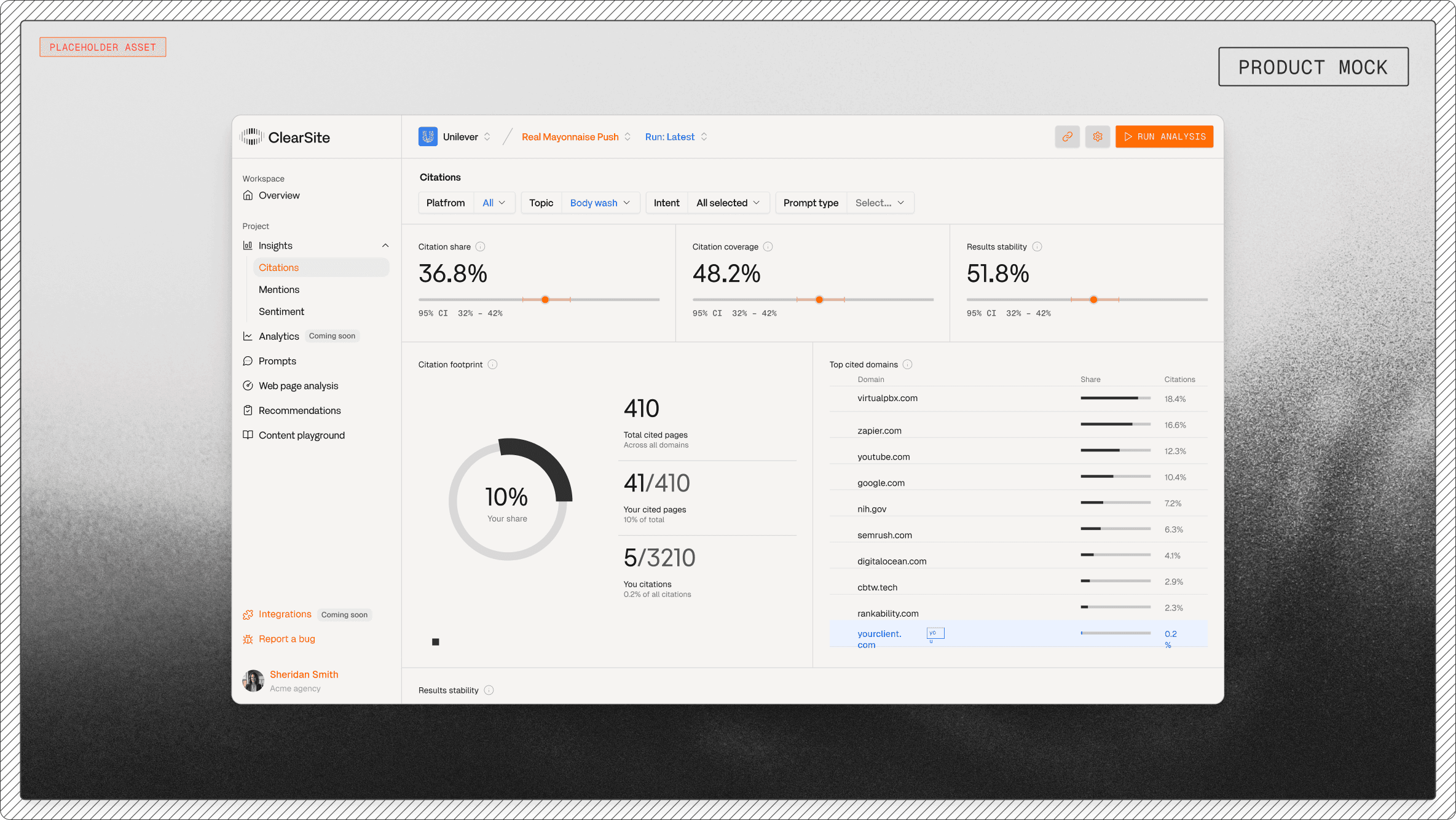
IQRush gives teams the flexibility to explore AI visibility data and the controls to know when it is decision-grade.
IQRush gives teams the flexibility to explore AI visibility data and the controls to know when it is decision-grade.
AI visibility needs a new measurement system.
OUR SOLUTION
AI visibility needs a new
measurement system.
IQRush gives teams the flexibility to explore AI visibility data and the controls to know when it is decision-grade.
AI visibility needs a new measurement system.
HOW IT WORKS
The method makes
The method makes the difference.
the difference.
Before AI visibility can be optimized, it must be measured against a verified baseline.
[01]
Stability Detection
We measure when AI-engine results stop shifting, qualifying a defensible baseline before any suggestions are made.
[01]
Stability Detection
We measure when AI-engine results stop shifting, qualifying a defensible baseline before any suggestions are made.
[02]
Sufficiency Check
We pinpoint when results have stabilized and additional sampling stops paying off, so you stop spending on data you don’t need.
[02]
Sufficiency Check
We pinpoint when results have stabilized and additional sampling stops paying off, so you stop spending on data you don’t need.
[03]
Cluster & Track
We segment URLs into ranked clusters so movement is measured against the right competitive set, not the whole field.
[03]
Cluster & Track
We segment URLs into ranked clusters so movement is measured against the right competitive set, not the whole field.
[04]
Drift Detection
We watch for genuine shifts once a baseline is verified, and screen out noise. Drift is only declared when our math says it's real.
[04]
Drift Detection
We watch for genuine shifts once a baseline is verified, and screen out noise. Drift is only declared when our math says it's real.
[05]
Answer Engine Scoring
We score against the same factors each answer engine uses to rank sources. So you understand not just where you appear, but why.
[05]
Answer Engine Scoring
We score against the same factors each answer engine uses to rank sources. So you understand not just where you appear, but why.
[06]
Flexible Analytics
We give teams the flexibility to slice by prompt, engine, market, or funnel stage, with mathematical guardrails that flag when a view is too narrow to be decision-grade.
[06]
Flexible Analytics
We give teams the flexibility to slice by prompt, engine, market, or funnel stage, with mathematical guardrails that flag when a view is too narrow to be decision-grade.
What accuracy earns
Cut wasted spend
Save time and money by avoiding unnecessary content rewrites, optimization sprints, and strategy pivots based on unstable data.
Defend every number
Every metric comes with confidence intervals attached and methodology you can cite. This is decision-grade data you can rely on.
Respond to what’s real
We separate genuine ranking shifts from model variance. Act with confidence when it matters and hold the line when it doesn't.
Know what's working
Once results stabilize, IQRush clusters your competitive landscape so you can see exactly which content is gaining traction in AI results and which gaps are worth closing.
HOW IT WORKS
The method makes
The method makes the difference
Before AI visibility can be optimized, it must be measured against a verified baseline.
[01]
Stability Detection
We measure when AI-engine results stop shifting, qualifying a defensible baseline before any suggestions are made.
[02]
Sufficiency Check
We pinpoint when results have stabilized and additional sampling stops paying off, so you stop spending on data you don’t need.
[03]
Cluster & Track
We segment URLs into ranked clusters so movement is measured against the right competitive set, not the whole field.
[04]
Drift Detection
We watch for genuine shifts once a baseline is verified, and screen out noise. Drift is only declared when our math says it's real.
[05]
Answer Engine Scoring
We score against the same factors each answer engine uses to rank sources. So you understand not just where you appear, but why.
[06]
Flexible Analytics
We give teams the flexibility to slice by prompt, engine, market, or funnel stage, with mathematical guardrails that flag when a view is too narrow to be decision-grade.
What accuracy earns
Cut wasted spend
Save time and money by avoiding unnecessary content rewrites, optimization sprints, and strategy pivots based on unstable data.
Defend every number
Every metric comes with confidence intervals attached and methodology you can cite. This is decision-grade data you can rely on.
Respond to what’s real
We separate genuine ranking shifts from model variance. Act with confidence when it matters and hold the line when it doesn't.
Know what's working
Once results stabilize, IQRush clusters your competitive landscape so you can see exactly which content is gaining traction in AI results and which gaps are worth closing.
FIXING AI SEARCH VISIBILITY
Your dashboard isn't broken.
The measurement standard is.
How IQRush delivers certainty and removes doubt surrounding AI search visibility.
YOU’VE PROBABLY ASKED
WHY IT HAPPENS
our solution
Why does the answer to the same query change?
AI engines return different answers to the same query every time. That's not a bug, it's how probabilistic systems work. Any single measurement is one draw from a distribution, not a number you can plan against.
IQRush runs the same query hundreds of times and measures when the results stop moving. That convergence point is the baseline. You're not planning against one draw. You're planning against a verified distribution.
My metrics keep moving. How do I know what’s real?
You don't. Not without knowing how much variation is normal. Without a verified baseline, every routine fluctuation looks like real brand movement.
IQRush quantifies the normal range of variation before reporting any movement. If a metric shifts within its confidence interval, we don't call it signal. You only hear about change when the math says it's real.
We ran the same project twice and got different top URLs. Which one is right?
AI engines return different answers to the same query every time. That's not a bug, it's how probabilistic systems work. Any single measurement is one draw from a distribution, not a number you can plan against.
IQRush runs enough samples to find which URLs consistently lead the distribution, then clusters them by tier. The question isn't which single run was right. It's which domains actually own the position.
Did our content work? Visibility is up but I can't tell if we caused it.
If your baseline wasn't verified before the content went live, attribution is guesswork. A good optimization can look bad. A bad one can look good.
IQRush establishes a verified baseline before your content goes live. When visibility moves, you have something real to measure against. The attribution holds.
I need to cut this by engine, by prompt, by competitor, but when I slice it, nothing holds.
Every filter shrinks the sample. A narrower view can look precise while being statistically meaningless. The number is real, but what it means isn't.
IQRush tells you when a slice is too small to trust. Every segment comes with confidence intervals, so you know which cuts are meaningful and which ones aren't.
Should we act on this recommendation? I don't want to brief the wrong content.
If the signal going in wasn't verified, the recommendation can't be defended. At around $750 per piece of content, the cost of optimizing against noise compounds fast.
IQRush verifies the signal before the recommendation is made. If the data isn't stable enough to act on, we say so before you brief a single piece of content.
This seems like an insane oversight. Are these problems actually real?
Yes. The industry will haemorrhage roughly $2 billion this year alone optimizing content based on misunderstood insights and bad math.
IQRush published the research that proved it. Over 500,000 citations tracked across three major AI platforms. The findings are on arXiv and under peer review. The math is public. The problem is real.
Why does the answer to the same query change?
My metrics keep moving. How do I know what’s real?
We ran the same project twice and got different top URLs. Which one is right?
Did our content work? Visibility is up but I can't tell if we caused it.
I need to cut this by engine, by prompt, by competitor, but when I slice it, nothing holds.
Should we act on this recommendation? I don't want to brief the wrong content.
This seems like an insane oversight. Are these problems actually real?
YOU’VE PROBABLY ASKED
OUR DIFFERENCE
What does it look like when the data
is actually ready to act on?
to act on?
IQRush verifies the baseline, quantifies uncertainty, and tells you which insights are ready to act on.
FIXING AI SEARCH VISIBILITY
Your dashboard isn't broken.
The measurement standard is.
How IQRush delivers certainty and removes doubt surrounding AI search visibility.
YOU’VE PROBABLY ASKED
WHY IT HAPPENS
our solution
Why does the answer to the same query change?
AI engines return different answers to the same query every time. That's not a bug, it's how probabilistic systems work. Any single measurement is one draw from a distribution, not a number you can plan against.
IQRush runs the same query hundreds of times and measures when the results stop moving. That convergence point is the baseline. You're not planning against one draw. You're planning against a verified distribution.
My metrics keep moving. How do I know what’s real?
You don't. Not without knowing how much variation is normal. Without a verified baseline, every routine fluctuation looks like real brand movement.
IQRush quantifies the normal range of variation before reporting any movement. If a metric shifts within its confidence interval, we don't call it signal. You only hear about change when the math says it's real.
We ran the same project twice and got different top URLs. Which one is right?
AI engines return different answers to the same query every time. That's not a bug, it's how probabilistic systems work. Any single measurement is one draw from a distribution, not a number you can plan against.
IQRush runs enough samples to find which URLs consistently lead the distribution, then clusters them by tier. The question isn't which single run was right. It's which domains actually own the position.
Did our content work? Visibility is up but I can't tell if we caused it.
If your baseline wasn't verified before the content went live, attribution is guesswork. A good optimization can look bad. A bad one can look good.
IQRush establishes a verified baseline before your content goes live. When visibility moves, you have something real to measure against. The attribution holds.
I need to cut this by engine, by prompt, by competitor, but when I slice it, nothing holds.
Every filter shrinks the sample. A narrower view can look precise while being statistically meaningless. The number is real, but what it means isn't.
IQRush tells you when a slice is too small to trust. Every segment comes with confidence intervals, so you know which cuts are meaningful and which ones aren't.
Should we act on this recommendation? I don't want to brief the wrong content.
If the signal going in wasn't verified, the recommendation can't be defended. At around $750 per piece of content, the cost of optimizing against noise compounds fast.
IQRush verifies the signal before the recommendation is made. If the data isn't stable enough to act on, we say so before you brief a single piece of content.
This seems like an insane oversight. Are these problems actually real?
Yes. The industry will haemorrhage roughly $2 billion this year alone optimizing content based on misunderstood insights and bad math.
IQRush published the research that proved it. Over 500,000 citations tracked across three major AI platforms. The findings are on arXiv and under peer review. The math is public. The problem is real.
Why does the answer to the same query change?
My metrics keep moving. How do I know what’s real?
We ran the same project twice and got different top URLs. Which one is right?
Did our content work? Visibility is up but I can't tell if we caused it.
I need to cut this by engine, by prompt, by competitor, but when I slice it, nothing holds.
Should we act on this recommendation? I don't want to brief the wrong content.
This seems like an insane oversight. Are these problems actually real?
YOU’VE PROBABLY ASKED
OUR DIFFERENCE
What does it look like when
the data is actually ready
to act on?
IQRush verifies the baseline, quantifies uncertainty, and tells you which insights are ready to act on.
FIXING AI SEARCH VISIBILITY
Your dashboard isn't broken. The measurement standard is.
The measurement standard is.
How IQRush delivers certainty and removes doubt surrounding AI search visibility.
YOU’VE PROBABLY ASKED
WHY IT HAPPENS
our solution
Why does the answer to the same query change?
AI engines return different answers to the same query every time. That's not a bug, it's how probabilistic systems work. Any single measurement is one draw from a distribution, not a number you can plan against.
IQRush runs the same query hundreds of times and measures when the results stop moving. That convergence point is the baseline. You're not planning against one draw. You're planning against a verified distribution.
My metrics keep moving. How do I know what’s real?
You don't. Not without knowing how much variation is normal. Without a verified baseline, every routine fluctuation looks like real brand movement.
IQRush quantifies the normal range of variation before reporting any movement. If a metric shifts within its confidence interval, we don't call it signal. You only hear about change when the math says it's real.
We ran the same project twice and got different top URLs. Which one is right?
AI engines return different answers to the same query every time. That's not a bug, it's how probabilistic systems work. Any single measurement is one draw from a distribution, not a number you can plan against.
IQRush runs enough samples to find which URLs consistently lead the distribution, then clusters them by tier. The question isn't which single run was right. It's which domains actually own the position.
Did our content work? Visibility is up but I can't tell if we caused it.
If your baseline wasn't verified before the content went live, attribution is guesswork. A good optimization can look bad. A bad one can look good.
IQRush establishes a verified baseline before your content goes live. When visibility moves, you have something real to measure against. The attribution holds.
I need to cut this by engine, by prompt, by competitor, but when I slice it, nothing holds.
Every filter shrinks the sample. A narrower view can look precise while being statistically meaningless. The number is real, but what it means isn't.
IQRush tells you when a slice is too small to trust. Every segment comes with confidence intervals, so you know which cuts are meaningful and which ones aren't.
Should we act on this recommendation? I don't want to brief the wrong content.
If the signal going in wasn't verified, the recommendation can't be defended. At around $750 per piece of content, the cost of optimizing against noise compounds fast.
IQRush verifies the signal before the recommendation is made. If the data isn't stable enough to act on, we say so before you brief a single piece of content.
This seems like an insane oversight. Are these problems actually real?
Yes. The industry will haemorrhage roughly $2 billion this year alone optimizing content based on misunderstood insights and bad math.
IQRush published the research that proved it. Over 500,000 citations tracked across three major AI platforms. The findings are on arXiv and under peer review. The math is public. The problem is real.
Why does the answer to the same query change?
My metrics keep moving. How do I know what’s real?
We ran the same project twice and got different top URLs. Which one is right?
Did our content work? Visibility is up but I can't tell if we caused it.
I need to cut this by engine, by prompt, by competitor, but when I slice it, nothing holds.
Should we act on this recommendation? I don't want to brief the wrong content.
This seems like an insane oversight. Are these problems actually real?
YOU’VE PROBABLY ASKED
OUR DIFFERENCE
What does it look like when the data is actually ready to act on?
is actually ready to act on?
to act on?
IQRush verifies the baseline, quantifies uncertainty, and tells you which insights are ready to act on.
OUR MODEL
OUR MODEL
Pay for the signal,
Pay for the signal, not the noise.
not the noise.
Most AI visibility tools price by volume because they don't know when to stop measuring. Our sufficiency math does. You pay for verified answers. Never the noise.
Most AI visibility tools price by volume because they don't know when to stop measuring. Our sufficiency math does. You pay for verified answers. Never the noise.
“
Our brands don’t understand how answer engines rank and recommend their products. In just a few minutes, IQRush delivers data-driven scoring, specific recommendations, and connects it all with e-commerce outcomes so they can focus on what matters to drive growth.



Ryan
Head of Strategy
Fedex
“
Our brands don’t understand how answer engines rank and recommend their products. In just a few minutes, IQRush delivers data-driven scoring, specific recommendations, and connects it all with e-commerce outcomes so they can focus on what matters to drive growth.
Ryan
Head of Strategy
Fedex
OUR MODEL
Pay for the signal,
Pay for the signal, not the noise.
Most AI visibility tools price by volume because they don't know when to stop measuring. Our sufficiency math does. You pay for verified answers. Never the noise.
“
Our brands don’t understand how answer engines rank and recommend their products. In just a few minutes, IQRush delivers data-driven scoring, specific recommendations, and connects it all with e-commerce outcomes so they can focus on what matters to drive growth.
Ryan
Head of Strategy
Fedex
spacer