

" height="19.8785px" id="VwPsyD3pt" width="20px"/></svg>)
" height="19.9961px" id="ObwXq6pQg" width="19.9883px"/><path d="M 5.137 0 C 2.301 0 0 2.301 0 5.137 C 0 7.973 2.301 10.273 5.137 10.273 C 7.973 10.273 10.273 7.973 10.273 5.137 C 10.273 2.301 7.973 0 5.137 0 Z M 5.137 8.469 C 3.297 8.469 1.805 6.977 1.805 5.137 C 1.805 3.297 3.297 1.805 5.137 1.805 C 6.977 1.805 8.469 3.297 8.469 5.137 C 8.469 6.977 6.977 8.469 5.137 8.469 Z" fill="rgb(247, 249, 252)" height="10.27342px" id="XYnTId4wn" transform="translate(4.863 4.863)" width="10.27342px"/><path d="M 2.399 1.199 C 2.399 1.863 1.859 2.398 1.199 2.398 C 0.535 2.398 0 1.859 0 1.199 C 0 0.535 0.539 0 1.199 0 C 1.859 0 2.399 0.539 2.399 1.199 Z" fill="rgb(247, 249, 252)" height="2.3984400000000003px" id="oz7Pp54No" transform="translate(14.141 3.461)" width="2.398500000000002px"/></svg>)
" height="20px" id="Mz7QRCoiD" width="20px"/></svg>)

Todd Paris
Oct 9, 2025
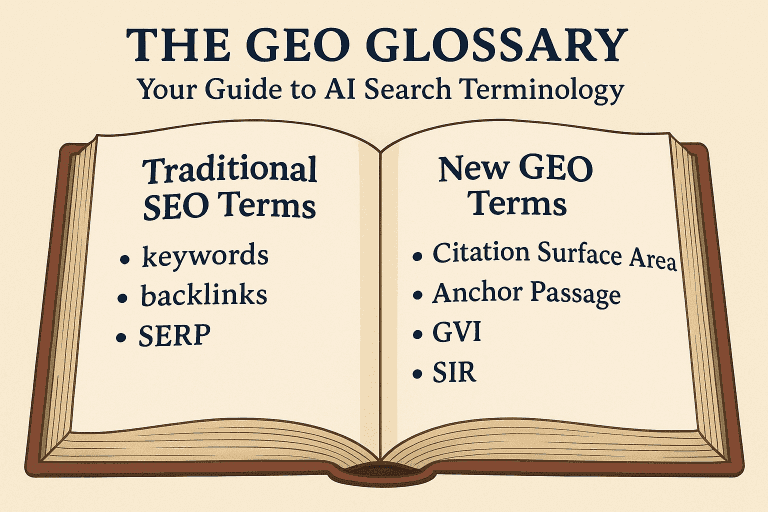
Why Generative Engine Optimization (GEO) Matters Now?
Search is undergoing its biggest transformation in two decades. AI-powered search experiences like Google’s AI Overviews, Microsoft Copilot, and Perplexity are fundamentally changing how users discover information. Instead of clicking through blue links, users now receive AI-generated answers that synthesize information from multiple sources.
This shift demands a new discipline: Generative Engine Optimization (GEO). SEO developed its own vocabulary of keywords, ranking factors, and link strategies. Similarly, GEO has emerged with its own essential terminology.
In this guide, you’ll learn:
Core GEO concepts and how they differ from traditional SEO
Key metrics for measuring AI search visibility
Practical techniques to optimize content for generative AI
Common challenges and how to address them
Whether you’re a marketer, SEO professional, or business leader, this comprehensive glossary will guide you. It will help you navigate the AI-search landscape with confidence.
Part 1: Understanding the GEO Landscape
What is GEO?
Generative Engine Optimization (GEO) is a methodology used to enhance a company’s visibility in AI-based web searches. As large language models (LLMs) increasingly power consumer search experiences, GEO ensures your web-based information appears in AI-generated results.
GEO is also known as:
Artificial Intelligence Optimization (AIO)
Agentic SEO (ASEO)
Key difference from SEO: SEO optimizes for ranking in blue-link results. GEO optimizes for inclusion and citation in AI-generated answers.
The New Search Results Page: Understanding Generative SERPs
A Generative SERP (Search Engine Results Page) blends AI-generated answers with traditional search listings. Instead of only showing ranked links, it features a generative summary that synthesizes information from multiple sources.
Components of a Generative SERP:
AI-generated snippet at the top
Source citations with clickable references
Suggested follow-up questions
Traditional paid and organic listings below
AI Overviews and Generative Answers Explained
An AI Overview (also called a Generative Answer) is the synthesized, natural-language response. It appears at the top of results pages. These answers combine information from multiple sources using large language models (LLMs) and Retrieval-Augmented Generation (RAG).
Key characteristics:
Composed by AI models using multiple sources
Includes citation links (visibility varies)
Dynamic length based on query complexity
Appears above traditional search results
Why it matters for your business:
If cited, drives high-quality traffic without top rankings
Users may get complete answers without clicking (zero-click risk)
Brand visibility depends on proper content structuring
Part 2: Core GEO Concepts for Content Optimization
Anchor Passages: Your Content’s Hook into AI Answers
An anchor passage is the specific segment of your content most likely to be quoted or cited by a generative search engine. It serves as the primary connection between your content and AI-generated answers.
What makes an effective anchor passage:
Contains the clearest, most concise version of a relevant fact
Semantically closest match to user queries
Self-contained and context-complete
Example: For a cold brew coffee company, if users ask “What’s the ideal steeping time for cold brew coffee?”, an effective anchor passage might read:
“According to [Your Brand], the ideal steeping time for cold brew coffee is 14 to 18 hours, which balances extraction and flavor without introducing bitterness.”
Answer Chunking: Breaking Down Complex Information
Answer Chunking is the practice of breaking complex information into smaller, self-contained sections that AI can easily extract and use.
Why it works:
AI models can reliably pull discrete passages
Prevents context confusion
Each chunk becomes a potential citation opportunity
Think of it this way: Answer chunks are individual fishing lines in the water. Citation surface area is the total number of hooks you have deployed.
Citation Surface Area: Maximizing Your Visibility Opportunities
Citation Surface Area refers to the number of opportunities your content gives an AI model to reference it. It also includes opportunities to quote or link to it.
How to expand your citation surface area:
For a cold brew coffee business page, instead of one long paragraph, structure content with:
Bullet points for quick brewing methods
List of bean recommendations
FAQ on caffeine content in Q&A format
Storage and freshness tips in fact boxes
Each element is a citation unit that gives AI multiple reasons to pull from your content, regardless of query phrasing.
Fact Density: Quality Over Quantity
Fact Density measures how many clear, verifiable facts appear in a content section relative to filler or narrative.
Why high fact density matters:
AI models prefer extracting structured facts
Dense facts are easier to verify and present
Increases likelihood of citation in answers
Best practice: Balance readability with factual concentration—every paragraph should contain at least one clear, extractable fact.
Grounding Sources: Becoming the AI’s Foundation
Grounding Sources are the original, authoritative materials that generative AI systems retrieve and use to support answers. They serve as the factual anchor ensuring generated content is based on verifiable information.
How to become a grounding source:
Publish original research and data
Maintain authoritative, regularly updated content
Use clear attribution and citation practices
Establish topical authority in your domain
Part 3: Technical GEO Foundations
Understanding Knowledge Cutoffs
A Knowledge Cutoff is the latest point in time an AI model was trained on, determining whether your content is part of its internal knowledge.
Current knowledge cutoff dates:
GPT-5 main model: ~October 1, 2024
GPT-5 variants (mini/nano): ~May 31, 2024
Claude Sonnet 4, Opus 4, Opus 4.1: March 2025 training data (reliable cutoff: end of January 2025)
Important: Content published after the cutoff isn’t part of the model’s internal training but can still be retrieved through RAG-based search.
Retrieval-Augmented Generation (RAG) Explained
RAG is an AI technique that enhances language models by incorporating real-time information retrieval.
The three-step RAG process:
Retrieval: System retrieves pertinent information from indexed data
Augmentation: Retrieved information is integrated into the original query
Generation: Model generates response based on training plus augmented information
Why RAG matters for GEO: Your content can influence AI answers even if published after the model’s knowledge cutoff, as long as it’s indexed and retrievable.
Prompt Context Window: Understanding AI’s Memory Limits
The Prompt Context Window is the maximum amount of text (measured in tokens) an AI model can process simultaneously when generating a response.
Context window sizes:
Small window (GPT-3.5): ~16k tokens (~12,000 words)
Large window (GPT-4o, Claude Opus 4): 200k-300k tokens (~150,000-225,000 words)
Practical implication: If a user uploads a 100-page PDF into a 32k token limit model, content at the end may be ignored in the AI’s response.
Tokens: The Atomic Unit of AI Processing
A Token is a measurement unit of data that LLMs process. Tokens represent segments of text including words, subwords, characters, or punctuation marks—typically 4 bytes of plain text.
Why tokens matter:
LLMs operate on sequences of tokens
Provides a standardized metric for computational requirements
Used to calculate API costs and processing limits
Model Context Protocol (MCP): The Universal Connector
Model Context Protocol (MCP) is an open standard introduced by Anthropic in November 2024 that defines how AI models connect to external tools or data sources.
Think of MCP as: A USB-C port for AI—it standardizes how AI connects with Google Drive, Slack, GitHub, calendar APIs, or web crawling services without custom connectors for each case.
Continuous Indexing vs. Static Knowledge
Continuous Indexing is the frequency with which search engines regularly re-crawl, re-process, and re-embed content.
Key differences:
AI models: Use static knowledge with updates only during training runs
Search engines: Use live crawling and embedding pipelines, re-indexing frequently (sometimes hourly for high-priority content)
Part 4: Optimizing Content for AI Discovery
Conversational Relevance: Matching Natural Language
Conversational Relevance is the degree to which your content matches how users naturally ask questions in AI search environments.
How to optimize for conversational relevance:
Write in natural, question-and-answer format
Use complete sentences that mirror spoken language
Include common question phrasings in headers
Structure content to directly answer “who, what, when, where, why, how” queries
Keyword-to-Concept Mapping: Beyond Traditional Keywords
Keyword-to-Concept Mapping aligns traditional SEO keywords with the entities, topics, and relationships that AI models use to understand content.
Traditional SEO focus: “best CRM software for startups” GEO focus: Entities (CRM platforms), concepts (startup needs), relationships (software features to business outcomes)
Why it matters: AI models recognize semantic relationships and topical authority, not just keyword density.
Entity Optimization: Making Concepts Clear
Entity Optimization ensures people, places, brands, and concepts in your content are clearly defined for AI understanding.
Best practices:
Introduce entities with full names and context
Use consistent terminology throughout
Link related entities together
Provide clear definitions for specialized terms
Positive Prompt Injection: Ethical Content Structuring
Positive Prompt Injection is the intentional design of content to steer AI toward including it in outputs using ethical techniques.
Ethical techniques include:
Structuring content to match common query patterns
Using clear, definitive statements
Including explicit attribution to your brand
Creating self-contained, citation-ready passages
Note: “Positive” distinguishes this from unethical techniques designed to extract sensitive data or override safety instructions.
Structured Data Markup: Making Content Machine-Readable
Structured Data Markup involves adding schema and metadata so AI can parse meaning more easily.
Key implementation:
Use Schema.org vocabulary
Implement JSON-LD formatting
Mark up entities, products, articles, FAQs
Include breadcrumb navigation
llms.txt: The New Robot.txt for AI
llms.txt is a proposed web standard (introduced by Jeremy Howard of Answer.AI) consisting of a Markdown file placed at your website’s root (https://yourdomain.com/llms.txt).
Purpose: Serves as a curated, concise guide designed specifically for LLMs to efficiently understand essential site content.
What to include:
Site overview and purpose
Key content categories
Important pages and resources
Preferred citation format
Part 5: Measuring GEO Success
AI Visibility Benchmark Set: Defining Your Target Queries
The AI Visibility Benchmark Set is a curated list of 100-200 AI search terms used to optimize your brand and products’ visibility in AI chatbot searches.
What to include in your benchmark set:
Core product category terms
Industry use case descriptions
Pain points and decision criteria
Emerging tech trends
Thought leadership queries
Example for cold brew coffee company:
best cold brew coffee
what is cold brew coffee
cold brew coffee brands
cold brew vs iced coffee
how to make cold brew coffee
best store bought cold brew
ready to drink cold brew
cold brew concentrate
nitro cold brew coffee
strongest cold brew coffee
Generative Visibility Index (GVI): Your Composite Performance Score
Generative Visibility Index (GVI) is a composite metric measuring how visible your brand is across AI-generated search results for your defined target queries.
Formula: GVI = (Sum of weighted visibility scores across all queries) / (Total possible score)
Factors included:
Frequency of appearance
Position and prominence
Citation quality
Platform coverage
Source Inclusion Rate (SIR): How Often You’re Cited
Source Inclusion Rate (SIR) measures how often your specific source is referenced in AI-generated answers for relevant queries.
Formula: SIR = (Number of queries where your content appears) / (Total queries tested) × 100%
What a good SIR looks like:
10-20%: Baseline visibility
20-40%: Strong presence
40%+: Category leader status
Generative Click-Through Rate (GCTR): Converting Visibility to Traffic
Generative Click-Through Rate (GCTR) measures the percentage of times users click your link after it appears in an AI-generated answer.
Formula: GCTR = (Clicks from AI-generated citations) / (Total impressions in AI answers) × 100%
Why GCTR matters: High visibility without clicks means users are getting their answers without visiting your site (zero-click scenario).
Prominence Score: Where You Appear Matters
Prominence Score measures the percentage of times your company appears in the primary answer versus footnotes or secondary mentions.
Visibility tiers:
Primary mention: Featured in main answer text
Supporting citation: Referenced in explanation
Secondary mention: Listed in additional sources
Footnote: Cited but not prominent
Attribution Retention: Keeping Your Brand Visible
Attribution Retention measures how consistently AI credits your brand when using your information.
Tracking attribution retention:
Monitor brand mentions in AI responses
Compare explicit citations to paraphrased content
Identify where attribution is lost
Optimize content to maintain brand visibility
Best practices to improve retention:
Brand your data and statistics clearly
Use distinctive phrasing and frameworks
Include brand name in key facts and conclusions
Create branded methodologies and research
Part 6: Common GEO Challenges
Context Leakage: When Nearby Content Confuses AI
Context Leakage occurs when irrelevant or nearby information alters how AI interprets, summarizes, or cites your content.
How context leakage causes problems:
Drives hallucinations as AI attempts to resolve ambiguities
Leads to partial misrepresentation
Causes incorrect fact associations
Prevention strategies:
Use clear section breaks
Keep related facts together
Avoid ambiguous pronouns
Provide explicit context for each fact
Content Summarization Bias: How AI Might Distort Your Message
Content Summarization Bias is the tendency of AI to selectively prioritize and reframe specific details when summarizing content, potentially distorting emphasis or omitting key facts.
Common bias types:
Omission Bias: AI leaves out brand names or unique qualifiers to shorten summaries
Framing Bias: AI prioritizes secondary points over your primary intended message
Attribution Loss: AI paraphrases without explicitly mentioning the source
Neutralization: AI converts distinctive language into generic, neutral statements
Mitigation strategies:
Place critical brand mentions early and often
Use clear, unambiguous language
Structure key messages as standalone facts
Provide explicit framing statements
Hallucination: When AI Generates False Information
Hallucination refers to instances where AI generates false, misleading, or entirely fabricated information but presents it as factual.
Common hallucination types:
Fabricated references and citations
Incorrect facts and statistics
Imaginary concepts or relationships
Alternative perspective: Jules White, Professor at Vanderbilt University, suggests “hallucination” mischaracterizes the phenomenon—the LLM isn’t inventing information but rather attempting to answer with available data, similar to a student writing irrelevant information to avoid leaving an answer blank.
How to reduce hallucinations involving your content:
Provide clear, unambiguous facts
Include verification sources
Maintain high fact density
Avoid vague or contradictory statements
Zero-Click AI Search: The New Visibility Challenge
Zero-Click AI Search occurs when a user’s query is fully answered in the AI output without clicking through to any source.
The impact: Research by Athena Chapekis and Anna Lieb shows that when Google surfaces AI Overviews, users click traditional links only 8% of the time. When no AI summary appears, that number nearly doubles to 15%.
Strategies for zero-click scenarios:
Focus on brand awareness and authority building
Provide partial information that encourages clicks
Offer unique tools, calculators, or interactive content
Create gated premium content
Build direct relationships through email and community
Part 7: AI Platforms and Technologies
Major AI Chatbot Platforms
Understanding which AI platforms your audience uses is essential for GEO strategy.
Leading AI chatbot companies:
OpenAI – ChatGPT
Anthropic – Claude
Google – Gemini (formerly Bard)
Perplexity AI – Perplexity Assistant
Microsoft – Copilot
Mistral – Le Chat
Amazon – Q
xAI – Grok
DeepSeek – DeepSeek Chat
Platform differences matter: Each platform has different:
Knowledge cutoff dates
Retrieval methods
Citation practices
Context window sizes
Source preferences
Model Routing: How Multi-Model Systems Work
Model Routing is the process of deciding which model (or set of models) should handle a given request based on task requirements.
Routing factors:
Task type: Text vs. image vs. code generation
Complexity: Easy queries to small models, hard ones to large models
Domain specialty: Routing by subject expertise
Performance constraints: Balancing speed and accuracy
Example: ChatGPT-5 uses model routing to optimize for cost efficiency, response speed, and quality across different query types.
Meta Tags Optimization (MTO): The HTML Foundation
Meta Tags Optimization is the practice of crafting HTML metadata to enhance visibility and relevance in search results.
Key meta tags for GEO:
Title tag: Clear, descriptive page title
Meta description: Concise summary with key facts
Open Graph tags: Social media preview optimization
Schema markup: Structured data for entities
Author tags: Establishing content attribution
Why meta tags matter for AI: They provide structured information that AI systems use to interpret and categorize your content during retrieval.
Vectorization: How AI Processes Your Content
Vectorization is the process of converting data into numerical vectors that machine learning algorithms can process.
Why it matters: RAG systems require input data to be vectorized before retrieval and matching can occur.
What this means for GEO:
Content structure affects vector representation
Semantic similarity determines retrieval likelihood
Clear topic clustering improves vectorization quality
Part 8: Practical Implementation
Creating Your AI Visibility Benchmark Set
Step 1: Identify Core Categories
Product/service terms
Industry problems and solutions
Buying criteria and decision factors
Competitor comparison terms
Thought leadership topics
Step 2: Research Actual Queries
Analyze search console data
Review customer support questions
Monitor social media discussions
Survey sales team for common questions
Use AI to generate query variations
Step 3: Prioritize by Impact
Conversion potential
Search volume
Strategic importance
Competitive opportunity
Brand-building value
Step 4: Test and Refine
Run queries across multiple AI platforms
Document current visibility
Identify content gaps
Update quarterly based on results
Optimizing Existing Content for GEO
Audit Process:
Assess Current Structure
Evaluate fact density
Identify anchor passages
Review answer chunking
Check citation surface area
Identify Improvements
Add missing facts and data
Create clear section breaks
Develop FAQ sections
Include brand attribution
Implement Changes
Restructure for conversation relevance
Add structured data markup
Optimize meta tags
Create llms.txt file
Measure Results
Track SIR improvements
Monitor GCTR changes
Assess GVI movement
Gather AI output examples
Creating New GEO-Optimized Content
Content Planning Checklist:
[ ] Define target AI queries
[ ] Identify anchor passage opportunities
[ ] Plan answer chunk structure
[ ] Map keyword-to-concept relationships
[ ] Design citation surface area
[ ] Prepare brand attribution elements
[ ] Create structured data schema
[ ] Draft FAQ section
[ ] Include verification sources
[ ] Optimize meta tags
Writing Guidelines:
Lead with clear, factual statements
Use natural, conversational language
Include explicit brand attribution
Create self-contained passages
Add data and statistics
Provide context for all claims
Use descriptive headers
Break complex topics into chunks
Frequently Asked Questions (FAQs)
What is Generative Engine Optimization?
Generative Engine Optimization (GEO) is the methodology for enhancing your content’s visibility in AI-powered search experiences. Unlike traditional SEO, which focuses on ranking in link-based results, GEO optimizes for inclusion in AI-generated answers. It also targets citation in platforms like Google’s AI Overviews, ChatGPT, Claude, and Perplexity.
How is GEO different from SEO?
While SEO optimizes for rankings in blue-link search results, GEO optimizes for inclusion in AI-generated answers. SEO focuses on keywords and backlinks; GEO emphasizes fact density, answer chunking, conversational relevance, and citation surface area. Both disciplines complement each other in a comprehensive search strategy.
What are the most important GEO metrics to track?
The three core GEO metrics are:
Generative Visibility Index (GVI) – measures overall visibility across AI platforms
Source Inclusion Rate (SIR) – tracks how often you’re cited in AI answers
Generative Click-Through Rate (GCTR) – measures traffic from AI citations
Additional metrics include Prominence Score and Attribution Retention.
How do I measure my current GEO performance?
Start by creating an AI Visibility Benchmark Set of 100-200 relevant queries. Test these queries across major AI platforms (ChatGPT, Claude, Gemini, Perplexity) and document when your brand, content, or website appears. Calculate your SIR and track changes over time as you implement GEO optimizations.
What is an anchor passage and why does it matter?
An anchor passage is the specific segment of your content most likely to be quoted or cited by AI. It matters because it serves as your primary connection to AI-generated answers. Effective anchor passages are self-contained, factually dense, and semantically aligned with common user queries.
What are grounding sources in AI search?
Grounding sources are the original, authoritative materials that AI systems retrieve and use to support their answers. Often times when your content becomes a grounding source, it gets directly cited and linked. Further, it is also featured in AI-generated responses. This provides significant brand visibility and authority.
How does knowledge cutoff affect my GEO strategy?
Knowledge cutoff is the latest date included in an AI model’s training data. Content published after this date isn’t part of the model’s internal knowledge. It can still appear in results through Retrieval-Augmented Generation (RAG). This means recent content can be discovered and cited even by models trained months earlier.
What is zero-click AI search and should I worry about it?
Zero-click AI search occurs when users get complete answers without clicking any source links. Research shows users click traditional links only 8% of the time when AI Overviews appear. While concerning, you can address this by focusing on brand awareness, offering unique interactive content, and building direct audience relationships.
How can I prevent AI from misrepresenting my content?
To prevent misrepresentation, use high fact density, clear attribution statements, self-contained passages, and explicit context. Avoid ambiguous language, separate unrelated topics clearly, and structure content to minimize context leakage. Strong brand attribution throughout also helps maintain accuracy.
What is answer chunking and how do I implement it?
Answer chunking breaks complex information into small, self-contained sections that AI can easily extract. Implement it by:
Creating distinct sections with clear headers
Writing self-sufficient paragraphs
Using bullet points for lists
Adding FAQ-style Q&A sections
Providing complete context within each chunk
Should I optimize for all AI platforms equally?
Different AI platforms have varying market share, use cases, and user demographics. Prioritize based on where your audience searches. B2B audiences might favor ChatGPT and Claude, while consumer queries often use Google’s AI Overviews. Test your benchmark queries across platforms and focus where you see the most opportunity.
How do I create an llms.txt file?
Create a Markdown-formatted file at your website root (https://yourdomain.com/llms.txt) that provides AI models with a concise guide to your site. Include your site overview, key content categories, important pages, and preferred citation format. Keep it under 2,000 words and update it quarterly.
What is citation surface area and how do I expand it?
Citation surface area is the number of opportunities your content provides for AI to cite you. Expand it by:
Breaking content into multiple citation-ready sections
Creating FAQ pages
Adding data visualizations and charts
Including bullet-pointed lists
Developing comparison tables
Writing multiple angle approaches to topics
How does RAG impact my content strategy?
Retrieval-Augmented Generation (RAG) means AI can access your content even if published after the model’s training cutoff. This makes continuous content publishing valuable for GEO. Focus on creating authoritative, well-structured content that RAG systems can easily retrieve, parse, and cite.
What are the biggest GEO mistakes to avoid?
Common mistakes include:
Ignoring fact density in favor of fluffy content
Poor content structure that causes context leakage
Failing to include brand attribution
Writing only for humans without considering AI parsing
Not tracking GEO metrics
Optimizing for only one AI platform
Neglecting structured data markup
How often should I update my GEO strategy?
Review your AI Visibility Benchmark Set quarterly, as AI platforms evolve rapidly. Monitor your SIR and GVI monthly to catch changes early. Update your content continuously based on performance data, new AI features, and shifts in how models cite sources. GEO is an ongoing discipline, not a one-time project.
Can I use the same content for SEO and GEO?
Yes, but with adjustments. Clearly, good GEO content is also good SEO content, but requires additional structuring for AI consumption. Add answer chunking, increase fact density, include explicit attribution, and create FAQ sections. Finally, the same page can serve both traditional and AI search with proper optimization.
What is Model Context Protocol and why should I care?
Model Context Protocol (MCP) is Anthropic’s open standard for connecting AI models to external data sources. Moreover, it matters because it standardizes how AI accesses your content across different tools and platforms. As MCP adoption grows, having MCP-compatible content structures will improve your discoverability.
How do I handle content summarization bias?
Address summarization bias by:
Placing critical brand mentions early and frequently
Using clear, unambiguous language
Structuring key messages as standalone facts
Avoiding overly complex or nuanced statements
Testing how AI summarizes your content
Adjusting based on observed bias patterns
Is GEO only for large companies with big budgets?
No. GEO is accessible to businesses of all sizes. Many GEO optimizations are free: improving content structure, adding FAQs, including brand attribution, and increasing fact density. The main investment is time to audit, optimize, and measure. Small businesses can often compete effectively by creating highly targeted, authoritative content in their niche.
Conclusion: From Definition to Execution
Understanding GEO terminology is just the beginning. These concepts—from Grounding Sources and Answer Chunking to Attribution Retention and Positive Prompt Injection—are practical tools for adapting your content strategy to AI-driven search.
Key takeaways:
GEO is a practice, not a theory. Each concept represents an actionable lever: structuring content for Conversational Relevance, expanding Citation Surface Area, reducing Context Leakage, and tracking metrics like GCTR.
GEO continues to evolve. Just as SEO adapted through countless algorithm updates, GEO will change as models improve, indexing speeds increase, and interfaces shift.
The time to act is now. AI search is already influencing buying decisions, brand perception, and user pathways to your site.
Your next steps:
Audit existing content through the GEO lens:
Are we providing clean, self-contained facts?
Do we signal enough expertise to become a grounding source?
Is it easy for AI to credit us when summarizing our work?
Create your AI Visibility Benchmark Set of 100-200 target queries
Establish baseline metrics for SIR, GVI, and GCTR
Implement optimizations starting with highest-impact content
Measure, experiment, and refine continuously
Generative search isn’t replacing traditional search overnight, but it is reshaping how users discover information and make decisions. Organizations that build fluency in GEO now will secure a competitive advantage in this new era of AI-powered discovery.
The answers AI gives tomorrow will be shaped by the content you publish today. Make it count.
Quick Reference: GEO Terms Summary
AI Overview / Generative Answer: AI-generated summary synthesizing info from multiple sources
Anchor Passage: Specific segment most likely to be quoted by AI
Answer Chunking: Breaking information into standalone sections for easy AI extraction
Attribution Retention: Rate at which your brand remains credited when AI uses your content
Citation Surface Area: Number of opportunities your content offers for AI citation
Conversational Relevance: Alignment with natural language query patterns
Context Leakage: When irrelevant nearby text alters AI interpretation
Continuous Indexing: Regular re-crawling and re-processing of content
Fact Density: Concentration of verifiable facts relative to filler
Generative Click-Through Rate (GCTR): Percentage of AI impressions resulting in clicks
(GEO) Generative Engine Optimization : Practice of optimizing for generative search inclusion
Generative SERP: Search results combining AI answers with traditional listings
Grounding Sources: Authoritative sources AI retrieves to support answers
Keyword-to-Concept Mapping: Aligning keywords with AI-recognized concepts
Knowledge Cutoff: Most recent date in AI model’s training data
Positive Prompt Injection: Ethical content structuring to match AI prompts
Prompt Context Window: Maximum text AI can process at once
Retrieval-Augmented Generation (RAG): Technique where AI retrieves sources before generating answers
About the Author
Eric Mersch is a financial executive and board director. He is a 25-year seasoned financial leader. Eric drives business strategy and builds shareholder value across SaaS, Gen AI/ML, and hospitality industries. His career spans the full spectrum of financial leadership, from public company CFO roles to start-ups.
Related Resources:
[What is AEO/GEO? ]
[Link to AI search readiness assessment]
[AI Search Tools Guide]
Connect with us: Sign up for more information or a demo for the latest GEO insights and AI search trends.