

" height="19.8785px" id="VwPsyD3pt" width="20px"/></svg>)
" height="19.9961px" id="ObwXq6pQg" width="19.9883px"/><path d="M 5.137 0 C 2.301 0 0 2.301 0 5.137 C 0 7.973 2.301 10.273 5.137 10.273 C 7.973 10.273 10.273 7.973 10.273 5.137 C 10.273 2.301 7.973 0 5.137 0 Z M 5.137 8.469 C 3.297 8.469 1.805 6.977 1.805 5.137 C 1.805 3.297 3.297 1.805 5.137 1.805 C 6.977 1.805 8.469 3.297 8.469 5.137 C 8.469 6.977 6.977 8.469 5.137 8.469 Z" fill="rgb(247, 249, 252)" height="10.27342px" id="XYnTId4wn" transform="translate(4.863 4.863)" width="10.27342px"/><path d="M 2.399 1.199 C 2.399 1.863 1.859 2.398 1.199 2.398 C 0.535 2.398 0 1.859 0 1.199 C 0 0.535 0.539 0 1.199 0 C 1.859 0 2.399 0.539 2.399 1.199 Z" fill="rgb(247, 249, 252)" height="2.3984400000000003px" id="oz7Pp54No" transform="translate(14.141 3.461)" width="2.398500000000002px"/></svg>)
" height="20px" id="Mz7QRCoiD" width="20px"/></svg>)

Ron Sielinkski
Oct 9, 2025
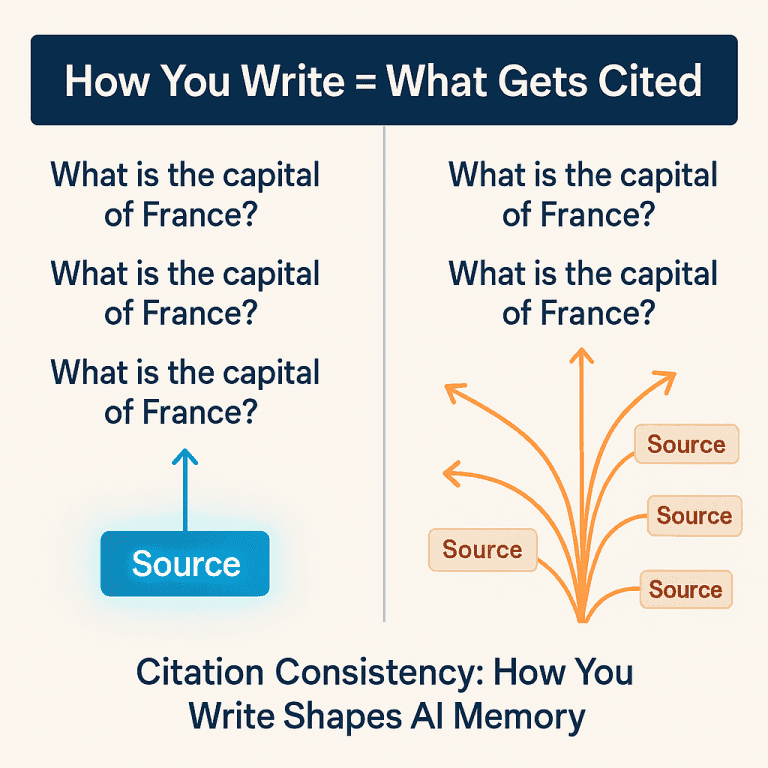
Answer engines are probabilistic in nature: you can ask the same question twice, but you'll rarely get the exact same answer. The responses might look similar, ideas restated in different ways, facts reordered, or details dropped and added. Here's a simple example: Ask "How do photoelectric smoke alarms work?" twice, and you might get two slightly different paragraphs. The facts stay intact, but the sentences, structure, and sometimes even the sources, change.
But what happens when you ask hundreds of related questions, not the same query, but dozens or hundreds about the same topic? Do answer engines repeat themselves? And if they do, do they cite the same sources each time?
If I'm a brand, and I see an answer engine cite my content in one response, how sure can I be that it will cite me again in the future?
To find out, we asked Perplexity hundreds of questions across a range of topics, from smoke detectors to Bluetooth devices to generative search, and analyzed how consistently it cited sources.
What We Found
Answer engines do repeat themselves. The same ideas show up again and again, sometimes hundreds of times, across semantically similar questions.
They don't always cite the same sources. Even when the wording and meaning are effectively identical, the supporting links can change.
Clarity matters The more assertive, readable, and numerically grounded a statement is, the more consistently the model sticks to the same source. In other words: how you write a claim shapes not only how humans interpret it, but how models retrieve it.
How We Measured It
We analyzed around 1,500 responses spanning three domains: smoke detectors, generative search (GEO), and Bluetooth devices. For each user's intent, we generated multiple paraphrases of the same question, then broke each answer into individual statements.
We grouped equivalent statements, those expressing the same idea in different words, into what we call "claim clusters." For example:
"Photoelectric alarms detect smoldering fires faster than ionization alarms."
"Ionization sensors respond slower to smoldering fires than photoelectric units."
"In smoldering tests, photoelectric beats ionization."
These all express the same underlying fact. Each cluster let us measure citation consistency: whether the model kept citing the same source domain or drifted to new ones.
We labeled each cluster as:
Consistent: same domain cited across runs.
Inconsistent: citations drifted between domains.
To see what drives that stability, we modeled three intuitive features of each statement: Assertiveness (A), Readability (R), and Numeric Density (N).
The Three Signals of Citation Stability
Assertiveness — One Clear Claim
Assertiveness captures how decisively a statement makes its claim. Sentences that say "is" or "supports" are more stable than ones that say "might" or "could." We quantified assertiveness using a weighted mix of linguistic cues: superlatives, numbers, brand names, and modal verbs. High A: "Bluetooth LE Audio supports LC3." Low A: "Bluetooth LE Audio might include newer codecs."
💡 Key insight: Assertive statements narrow retrieval to one clear evidence base. Hedged or uncertain phrasing opens multiple interpretations, and multiple possible sources.
Readability — Short and Plain Wins
Measured via Flesch Reading Ease, readability had the strongest stabilizing effect in our runs. High R (70–80): "The GEO market grew 15% in 2024 (Company X)." Low R (20–30): "The GEO sector experienced a year-over-year expansion of approximately 15% in 2024, as evidenced by Company X's report, which integrates panel-weighted estimates across heterogeneous subsegments."
💡 Key insight: Short, plain sentences align with how authoritative sources phrase the same idea. Long, clause-heavy phrasing introduces extraneous tokens that confuse retrieval.Numeric Density — One Number Anchors, Too Many Drift
Numbers can help or hurt depending on how many you use. We measured numeric density (N) as the ratio of numbers to total tokens and found a U-shaped effect:
– Too few numbers = vague and unanchored.
– One number = best stability.
– Too many = conflicting anchors.
– Stable: "Adoption grew 12% in 2023."
– Drift-prone: "Adoption was 12% (2023), 18% (2024), 25% (2025)."
💡 Key insight: Treat numbers as anchors, not confetti.
What the Models Showed
We tested several classifiers: Logistic Regression, Random Forest, and Gradient Boosting, using only A, R, and N as inputs.
Even with just these three features, the simplest model (Logistic Regression) reached around 0.61 macro-F1, outperforming chance and tree-based models. The takeaway: a small handful of textual properties predict whether a model's citation behavior will remain stable or drift.
Case Studies: Same Claim, Drifting Citations
Smoke Detectors
Stable: "Photoelectric alarms detect smoldering fires faster than ionization alarms (UL-217)."→ Cited official standards (UL-217, manufacturer docs).
Drift-prone: "Relative to ionization devices, photoelectric sensing modalities demonstrate superior responsiveness under UL-217 smoldering-combustion tests (1.5–3% obscuration per foot)."→ Cited vendor blogs and consumer articles.
Why: The stable version is short, assertive, and numerically moderate. The drift version packs too many clauses and numbers.
✏️ Lesson: Keep the core claim in one sentence. Put lab details in a separate note.GEO / Generative Search
Stable: "The GEO market grew 15% in 2024 (Company X 2024 report)."→ Cited the same flagship report each time.
Drift-prone: "Depending on volatility, the GEO market grew 10–20% last year, with some firms reporting +12% and others +18–19%."→ Cited a rotating mix of analyst notes and blogs.
Why: One number anchors retrieval; multiple figures pull the model toward different sources.
✏️ Lesson: If multiple figures exist, write one sentence per figure, each with its own citation.Bluetooth Devices
Stable: "Bluetooth LE Audio supports the LC3 codec (Bluetooth SIG)."→ Cited the Bluetooth SIG specification.
Drift-prone: "Bluetooth LE Audio might include newer codecs such as LC3, LC3plus, and aptX (various sources)."→ Cited vendor marketing and review blogs.
Why: The stable version uses a clear, normative statement matching the official spec. The drifting one adds enumeration noise and hedges.
✏️ Lesson: Lead with the governing source and avoid listing multiple options in one breath.
The Consistency Playbook
When you want answer engines to keep citing you, or any source, stay grounded in the following six rules:
Lead with the normative claim. One clear proposition anchors retrieval. Keep sentences short and plain. 10–20 words is ideal.
Use one precise number per sentence. A range counts as two; more than three, split it up. Cite the governing source first. Standards and official issuers are magnets for retrieval. Split multi-claim sentences. Each claim deserves its own citation.
Handle uncertainty without hedges. "Estimates vary by method" is better than "might have grown."
Limitations and Next Steps
This work was observational, not causal: we measured correlations, not interventions. Labels depend on clustering and URL canonicalization, so some noise remains. Future work should test these patterns across medical, legal, and other high-stakes verticals, and with multiple LLMs. Still, the pattern is clear: how you write affects whether a model remembers your source.
One-Sentence Takeaway
Write short, plain, assertive sentences with one verifiable number and a single governing source—that's the simplest way to keep answer engines citing you consistently.
Frequently Asked Questions
Do answer engines cite sources consistently?
Answer engines do repeat themselves with the same ideas appearing across similar questions, but they don't always cite the same sources. Even when the wording and meaning are identical, the supporting links can change. Citation consistency depends on how content is written—particularly its assertiveness, readability, and numeric density.
What makes content get cited repeatedly by answer engines?
Three factors drive citation stability: assertiveness (clear, decisive claims), readability (short, plain sentences with 10-20 words), and numeric density (one precise number per sentence). Content that combines all three factors is most likely to be cited consistently.
What is assertiveness in content writing for AI?
Assertiveness captures how decisively a statement makes its claim. Sentences using "is" or "supports" are more stable than ones using "might" or "could." Assertive statements narrow retrieval to one clear evidence base, while hedged phrasing opens multiple interpretations and possible sources.
Should I use multiple numbers in one sentence for AI content?
No. One precise number per sentence works best. The study found a U-shaped effect: too few numbers makes content vague, one number provides optimal stability, and too many numbers create conflicting anchors that cause citation drift. If you have multiple figures, write one sentence per figure with its own citation.
How does readability affect AI citations?
Readability has the strongest stabilizing effect on citations. Short, plain sentences (70-80 Flesch Reading Ease score) align with how authoritative sources phrase ideas. Long, clause-heavy sentences (20-30 score) introduce extra words that confuse retrieval systems and cause citation drift.
What is the best sentence length for answer engine optimization?
The ideal sentence length is 10-20 words. This range provides enough context for clarity while remaining simple enough for retrieval systems to match with authoritative sources. Sentences longer than this introduce complexity that can lead to citation inconsistency.
What sources do answer engines prefer to cite?
Answer engines show preference for normative, governing sources like official standards (e.g., UL-217), specifications (e.g., Bluetooth SIG), and flagship reports from established organizations. Content that clearly cites these authoritative sources first tends to maintain citation consistency across queries.