

" height="19.8785px" id="VwPsyD3pt" width="20px"/></svg>)
" height="19.9961px" id="ObwXq6pQg" width="19.9883px"/><path d="M 5.137 0 C 2.301 0 0 2.301 0 5.137 C 0 7.973 2.301 10.273 5.137 10.273 C 7.973 10.273 10.273 7.973 10.273 5.137 C 10.273 2.301 7.973 0 5.137 0 Z M 5.137 8.469 C 3.297 8.469 1.805 6.977 1.805 5.137 C 1.805 3.297 3.297 1.805 5.137 1.805 C 6.977 1.805 8.469 3.297 8.469 5.137 C 8.469 6.977 6.977 8.469 5.137 8.469 Z" fill="rgb(247, 249, 252)" height="10.27342px" id="XYnTId4wn" transform="translate(4.863 4.863)" width="10.27342px"/><path d="M 2.399 1.199 C 2.399 1.863 1.859 2.398 1.199 2.398 C 0.535 2.398 0 1.859 0 1.199 C 0 0.535 0.539 0 1.199 0 C 1.859 0 2.399 0.539 2.399 1.199 Z" fill="rgb(247, 249, 252)" height="2.3984400000000003px" id="oz7Pp54No" transform="translate(14.141 3.461)" width="2.398500000000002px"/></svg>)
" height="20px" id="Mz7QRCoiD" width="20px"/></svg>)

Tracie Kambies
Jul 29, 2025
AI vs Trad Search Differences
Are You AI Ready? Assessing Your Site’s AI Search Visibility & Health
AI readiness assessment, Answer Engine Optimization and AI Readiness
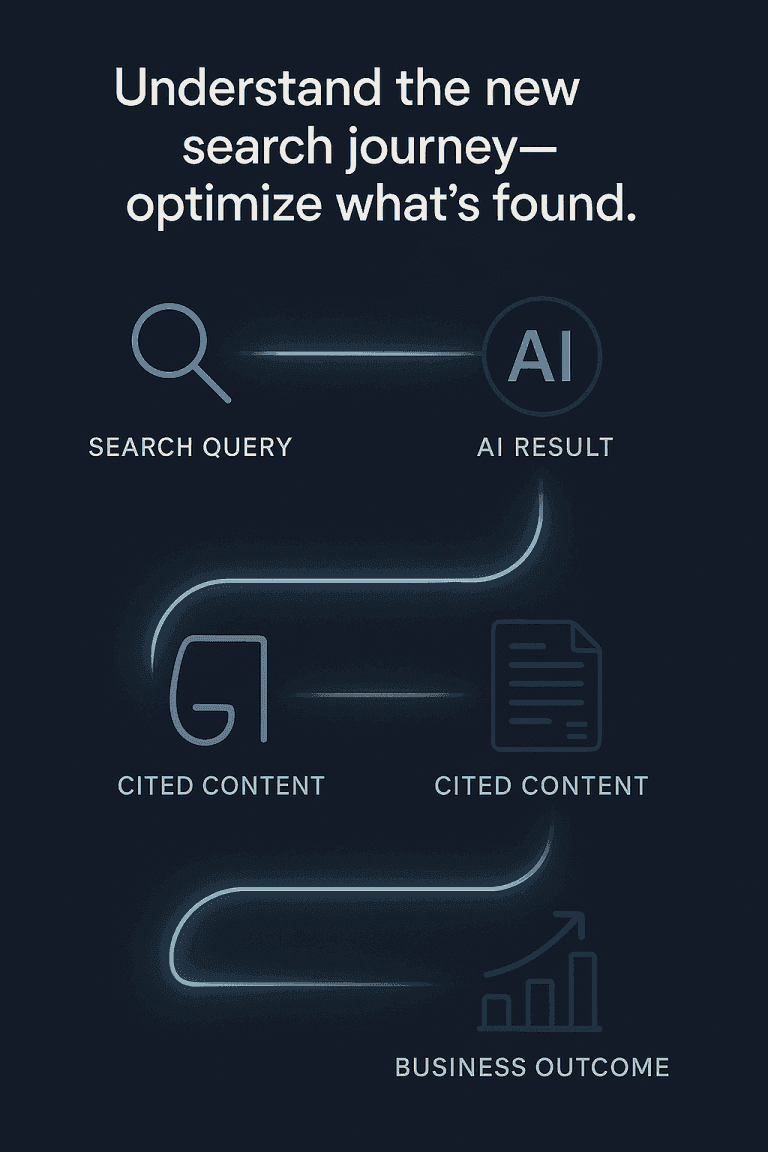
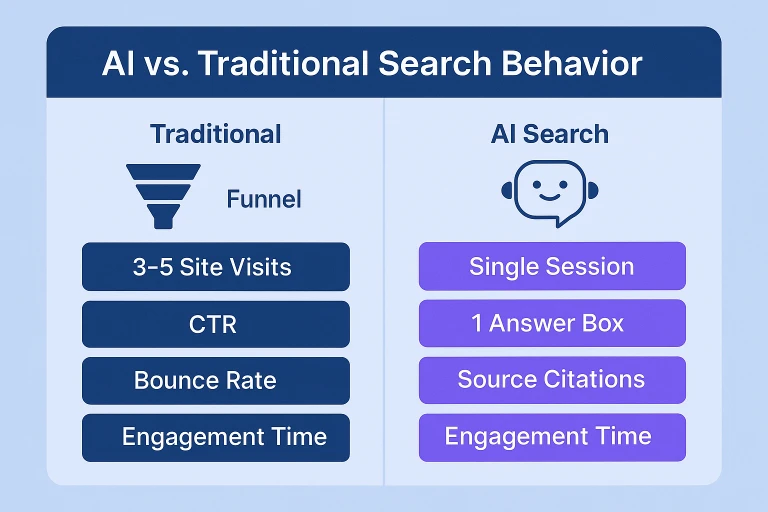
Search behavior is undergoing a fundamental shift. Traditional search was a linear funnel from awareness to action. AI-driven search changes that journey into a single conversational experience. A study from Semrush,” reveals that AI search visitors demonstrate 4.4 times higher value compared to traditional organic search visitors when measured by conversion rates.” Instead of clicking through sites, users get answers directly in chat form. Page visits, sign-ups, and other micro-conversions are being replaced by new engagement metrics. These include conversation length, follow-up questions, and source citation clicks. This is more than a minor change; it’s a fundamental restructuring of how customers discover and decide.
Critically, while interest in AI search has exploded (usage grew 1,200% last year). However, traditional search still dominates actual traffic by a huge margin. Google’s search volume remains 373× larger than ChatGPT’s, meaning today’s generative AI search represents only a tiny fraction of total searches., according to Search Engine Land. This situation creates tension for marketing leaders. The future is rushing toward AI-driven search. Meanwhile, the present still demands traditional SEO excellence. Many organizations are in a balancing act. They must invest enough in AI or risk falling behind. Conversely, they worry about investing too early and merely chasing hype. Early adopters in B2B are seeing promising results. Some report 55% improvement in ad conversion rates by leveraging AI search. Yet others caution that we’re still early in AI search’s lifecycle.
The takeaway is clear: AI-driven search is here. Marketers must ensure their Search strategy is AI-ready. They should achieve this without abandoning the channels that work today. This blog outlines how the IQRush platform helps bridge that gap. It provides a practical framework to assess your “AI search readiness.” This way, you can confidently navigate the transition.
Beyond Authority – Why Traditional SEO Advice Falls Short
With generative AI on the rise, much of the industry’s initial guidance has been to “stick to the SEO basics.” It’s true that strong SEO still matters—high Google rankings and domain authority do boost visibility in AI Overview results. There is small indicators that AI search engines leverage some of the top-ranked, authoritative content. They value E-E-A-T (Expertise, Experience, Authoritativeness, Trustworthiness) as sources input. However, it is not clear to what extent it is used in its full answers. In other words, many argue that improving traditional SEO increases your chances with AI. But does that apply to all aspects of SEO? It’s time to move beyond authority alone. Authority only takes you so far. You have to dig deeper into the elements.
Critical gaps that many teams overlook in this new landscape:
Content Structure & Metadata: Without proper schema markup or structured data, AI can’t parse your content’s key context. Even the most authoritative brand can be invisible.
Semantic Query Alignment: AI queries are conversational and intent-driven. Ranking for a broad keyword won’t help if you haven’t answered the long-tail questions users ask AI assistants.
Technical & Speed Optimizations: Slow pages or poor crawlability mean AI crawlers may skip or mis-index content. And because AI models update less frequently than Google, technical health is your first line of defense for fast visibility.
Measurement Blind Spots: Traditional metrics (click-through rates, organic traffic) don’t capture AI-driven engagement when answers surface directly in chat. Without new KPIs, teams are flying blind.
Our Approach to Assessment- Measuring Sites Differently
Capture and Analyze
When it comes to AI search, what you don’t see is just as important as what you do. Your site could be showing up in AI answers—or being skipped entirely—and unless you’re capturing that data, you’ll never know.
Here’s how we collect the insights that matter:
Capture AI Responses
We simulate how users actually search in AI tools by generating a wide range of natural-language queries. Then, we run those queries through AI assistants like ChatGPT, Bing, and Perplexity.
From each response, we extract:
Whether your site was cited
Where it ranked in any lists
What content was referenced (titles, snippets, links)
This lets you see exactly how and when your content appears—or doesn’t appear—in AI-generated results.
Analyze What Matters
All this data is stored and structured to support deep analysis:
Citation & position tracking to build your AI visibility score
Page-level metadata to uncover which features impact ranking
Historical trends so you can track visibility gains over time
We don’t just collect data for the sake of it. We collect it to answer one question: what’s helping or hurting your visibility in AI search right now?
Score and Classify
At its core, your Visibility Score reflects two things:
Citation Frequency: How often AI assistants (ChatGPT, Bing Chat, etc.) cite your pages.
List Position: The average rank where your content appears in an AI-generated list of sources.
Together, these metrics show whether AI-driven search is finding—and favoring—your site. High scores mean more brand exposure, zero-click authority, and “new” engagement signals beyond traditional clicks.
Why IQRush Stands Out
Most tools stop at authority metrics or technical checks. IQRush uniquely combines AI-specific citation data with an automated, predictive engine. It tells you where you stand today. It also forecasts which improvements (content, metadata, or structure) will move your score tomorrow. This provides you with a clear, competitive roadmap.
Key Features That Drive AI Visibility
We classify features into Machine-Readable (technical signals) and Human-Readable (content quality)—both inform LLMs when selecting sources.
Technical Features
Metadata Completeness
What it means: Title tags, meta descriptions, Open Graph, and structured data are all present.
Why it matters: Clear metadata helps AI embeddings identify and surface your content.
HTML Tag Usage
What it means: Proper H1–H3 headers, lists, emphasis tags, and semantic containers.
Why it matters: Well-structured markup boosts parseability for AI and accessibility for users.
Crawlability
What it means: Bots can reach and index your content
Why it matters: Unreachable pages won’t be surfaced in AI answers.
Sitemap Health
What it means: Your XML sitemap is accurate and up-to-date.
Why it matters: Ensures AI crawlers discover new or updated content quickly.
Non-Technical Features
Readability Grade
What it means: A score reflecting sentence length and vocabulary.
Why it matters: Clear, concise writing is more likely to be quoted verbatim.
Tone Consistency
What it means: Uniform voice and style across your content.
Why it matters: Cohesive tone signals authority and trustworthiness.
Content Originality
What it means: Your writing is unique compared to web-wide content.
Why it matters: AI assistants avoid duplicating near-identical copy.
Predict Future Gains
After scoring each page on the above features, we answer the question:
“If I improve Feature X by Y%, how much could my Citation Frequency or List Position improve?”
Feature Impact Analysis: Leverages historical changes—like readability boosts—to estimate visibility lift.
Prioritized Roadmap: Ranks features by projected ROI, so you know whether to tackle metadata first or refine your tone next.
Continuous Feedback: Re-runs the assessment after each update to show real-time visibility gains.
AI Search Readiness Framework
AI search readiness framework, IQRush platform
IQRush’s platform automates your AI search readiness audit across multiple dimensions, pinpointing gaps and prescribing actions. Below is one of the core categories we evaluate:
Analytics & Measurement Readiness
AI-driven metrics, attribution for AI search
Tracking AI-Driven Traffic: Detect and measure visits or referrals from AI assistants via custom analytics parameters or emerging AI-click logging tools.
Generative Engagement Metrics: Capture events like “AI suggestion click-through” or “follow-up question rate” in your dashboards.
Attribution Models: Ensure AI-first touchpoints are credited when leads convert—integrate with your CRM and adjust multi-touch attribution.
Benchmarking & KPIs: Define AI-specific success metrics (e.g., share-of-voice in AI answers) to track progress over time.
(Other readiness categories include Content & Technical SEO, Semantic Query Alignment, and Advertising & Analytics Setup. Each follows a similar audit-and-recommend structure.)
Conclusion – Get AI-Ready Now
The evolution of search is accelerating, and the margin for error is slim. Brands that proactively prepare for AI-driven search will capture early advantages in visibility. They will also engage more effectively. Meanwhile, those clinging to traditional SEO risk becoming invisible in the new paradigm.